
Influence of SBS Polymer on Asphalt Binder Characteristics and Moisture Resistance of Mixtures
Article Sidebar
Main Article Content
Abstract
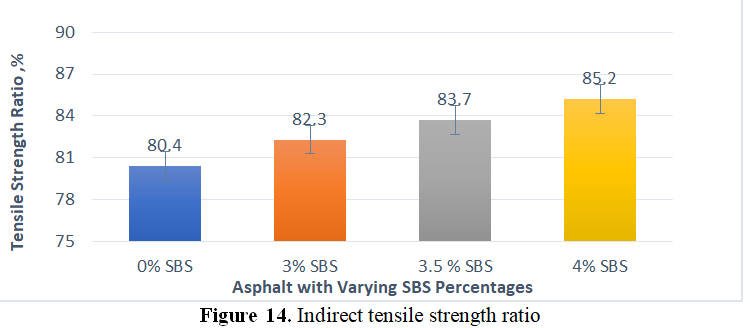
This study investigates the effect of Styrene-Butadiene-Styrene (SBS) polymer on asphalt binder properties and the performance of asphalt mixtures. Binder modification was evaluated through penetration, softening point, and rotational viscosity tests, showing that SBS addition enhanced binder stiffness, increased temperature resistance, and improved workability during mixing and compaction. Marshall tests indicated a progressive increase in stability and a gradual reduction in flow with higher SBS content, reflecting improved load-bearing capacity and reduced susceptibility to permanent deformation. Indirect tensile strength (ITS) tests under dry and wet conditions demonstrated enhanced moisture resistance in SBS-modified mixtures. Overall, SBS modification significantly improves both the rheological characteristics of the binder and the mechanical performance of asphalt mixtures, with the highest improvement observed at the 4% SBS content, providing an effective balance between stiffness, deformation resistance, workability, and moisture susceptibility.
Article Details
Section

This work is licensed under a Creative Commons Attribution-NonCommercial-ShareAlike 4.0 International License.
Licensed under a CC-BY license: https://creativecommons.org/licenses/by-nc-sa/4.0/
How to Cite


References
M. Chen, J. Geng, C. Xia, L. He, and Z. Liu, “A review of phase structure of SBS modified asphalt: Affecting factors, analytical methods, phase models and improvements,” Construction and Building Materials, vol. 294, p. 123610, 2021.
S. Wu and L. Montalvo, “Repurposing waste plastics into cleaner asphalt pavement materials: A critical literature review,” Journal of Cleaner Production, vol. 280, p. 124355, 2021.
G. Polacco, J. Stastna, D. Biondi, and L. Zanzotto, “Relation between polymer architecture and nonlinear viscoelastic behavior of modified asphalts,” Current Opinion in Colloid & Interface Science, vol. 11, no. 4, pp. 230–245, 2006.
L. M. Costa, H. M. Silva, J. R. Oliveira, and S. R. Fernandes, “Incorporation of waste plastic in asphalt binders to improve their performance in the pavement,” International Journal of Pavement Research and Technology, vol. 6, no. 4, pp. 457–464, 2013.
D. A. Gama, J. M. R. Júnior, T. J. A. de Melo, and J. K. G. Rodrigues, “Rheological studies of asphalt modified with elastomeric polymer,” Construction and Building Materials, vol. 106, pp. 290–295, 2016.
M. Z. H. Khan, S. Koting, H. Y. B. Katman, M. R. Ibrahim, A. M. Babalghaith, and O. Asqool, “Performance of high content reclaimed asphalt pavement (RAP) in asphaltic mix with crumb rubber modifier and waste engine oil as rejuvenator,” Applied Sciences, vol. 11, no. 11, p. 5226, 2021.
B. Gawdzik, T. Matynia, and K. Błażejowski, “The use of de-vulcanized recycled rubber in the modification of road bitumen,” Materials, vol. 13, no. 21, p. 4864, 2020.
M. K. Anwar, S. A. R. Shah, and H. Alhazmi, “Recycling and utilization of polymers for road construction projects: An application of the circular economy concept,” Polymers, vol. 13, no. 8, p. 1330, 2021.
M. Saltan, S. Terzi, and S. Karahancer, “Examination of hot mix asphalt and binder performance modified with nano silica,” Construction and Building Materials, vol. 156, pp. 976–984, 2017.
A. Bernier, A. Zofka, and I. Yut, “Laboratory evaluation of rutting susceptibility of polymer-modified asphalt mixtures containing recycled pavements,” Construction and Building Materials, vol. 31, pp. 58–66, 2012.
A. Modarres, “Investigating the toughness and fatigue behavior of conventional and SBS modified asphalt mixes,” Construction and Building Materials, vol. 47, pp. 218–222, 2013.
B. V. Kök and H. Çolak, “Laboratory comparison of the crumb-rubber and SBS modified bitumen and hot mix asphalt,” Construction and Building Materials, vol. 25, no. 8, pp. 3204–3212, 2011.
X. Lu, U. Isacsson, and J. Ekblad, “Low-temperature properties of styrene–butadiene–styrene polymer modified bitumens,” Construction and Building Materials, vol. 12, no. 8, pp. 405–414, 1998.
A. Behnood and M. M. Gharehveran, “Morphology, rheology, and physical properties of polymer-modified asphalt binders,” European Polymer Journal, vol. 112, pp. 766–791, 2019.
C. Vargas and A. El Hanandeh, “Systematic literature review, meta-analysis and artificial neural network modelling of plastic waste addition to bitumen,” Journal of Cleaner Production, vol. 280, p. 124369, 2021.
D. K. Özdemir, A. Topal, and B. Sengoz, “The influences of altering the mixing conditions on the properties of polymer modified bitumen: An overview,” Uludağ University Journal of The Faculty of Engineering, vol. 25, no. 2, pp. 1105–1116, 2020.
A. M. Babalghaith, H. A. Alsoliman, and A. S. Al-Suhaibani, “Comparison of rheological properties for polymer modified asphalt produced in Riyadh,” International Journal of Civil and Environmental Engineering, vol. 10, no. 2, pp. 197–201, 2016.
A. Pareek, T. Gupta, and R. K. Sharma, “Performance of polymer modified bitumen for flexible pavements,” International Journal of Structural and Civil Engineering Research, vol. 1, no. 1, pp. 77–86, 2012.
H. A. Alsolieman, A. M. Babalghaith, Z. A. Memon, A. S. Al-Suhaibani, and A. Milad, “Evaluation and comparison of mechanical properties of polymer-modified asphalt mixtures,” Polymers, vol. 13, no. 14, p. 2282, 2021.
C. Rivera, S. Caro, E. Arámbula-Mercado, D. B. Sánchez, and P. Karki, “Comparative evaluation of ageing effects on the properties of regular and highly polymer modified asphalt binders,” Construction and Building Materials, vol. 302, p. 124163, 2021.
SCRB/R9, General Specification for Roads and Bridges, Section R/9, Hot-Mix Asphalt Concrete Pavement, Revised Edition, State Corporation of Roads and Bridges, Ministry of Housing and Construction, Republic of Iraq, 2003.
C. Celauro, R. Teresi, and N. T. T. Dintcheva, “Effect of short-term and UV irradiation aging on the behaviour of SBS-modified bitumen,” Sustainability, vol. 14, no. 11, p. 6915, 2022.
H. Joni, H. Hussein, and H. Yawar, “Laboratory evaluation of modified asphalt with SBS polymer on rutting resistance of recycled pavement mixture,” Kufa Journal of Engineering, vol. 10, no. 3, pp. 19–32, 2019.
M. A. Ahmed, H. A. Khalid, and R. Farhan, “Influence of temperature and mixing speed on the performance of SBS-modified asphalt binder,” Journal of Materials in Civil Engineering, vol. 35, no. 6, p. 04023047, 2023.
S. T. Olalekan et al., "Bright substances with a dense distribution display a sizable distribution area when the SBS modifier content is increased," Heliyon, vol. 10, p. e30825, 2024. doi: 10.1016/j.heliyon.2024.e30825.
ASTM International, D6927-15 Standard Test Method for Marshall Stability and Flow of Asphalt Mixtures, ASTM, West Conshohocken, PA, USA, 2015.
ASTM International, ASTM D6931: Standard Test Method for Indirect Tensile (IDT) Strength of Bituminous Mixtures, Annual Book of Standards, vol. 04.03, ASTM, USA, 2012.
ASTM International, ASTM D4867: Standard Test Method for Effect of Moisture on Asphalt Concrete Paving Mixtures, Annual Book of Standards, vol. 04.03, ASTM, USA, 2012.
W. Huang, X. Li, Y. Zhang, and J. Chen, “Comprehensive study on the performance of SBS-modified asphalt binders: Rheological and thermal characterization,” Construction and Building Materials, vol. 416, p. 127642, 2024.
T. Wang, H. Liu, Q. Zhao, and F. Yang, “Preparation and properties of high-viscosity modified asphalt with a novel thermoplastic rubber,” Sustainability, vol. 15, no. 16, p. 12190, 2023.
Z. Cao, L. Xu, and P. Li, “Evolution of structure and properties of SBS-modified asphalt binder under different temperatures,” Buildings, vol. 14, no. 1, p. 291, 2024.
ASTM International, ASTM D5: Standard Test Method for Penetration of Bituminous Materials, Annual Book of Standards, vol. 04.03, ASTM, USA, 2012.
ASTM International, ASTM D36: Standard Test Method for Softening Point of Bitumen (Ring-and-Ball Apparatus), Annual Book of Standards, vol. 04.04, ASTM, USA, 2012.
ASTM International, ASTM D4402: Standard Test Method for Viscosity Determination of Asphalt at Elevated Temperatures Using a Rotational Viscometer, ASTM, West Conshohocken, PA, USA, 2013.