
A Review of Origami–Inspired Structure According to Pattern, Manufacturing and Application
Article Sidebar
Main Article Content
Abstract
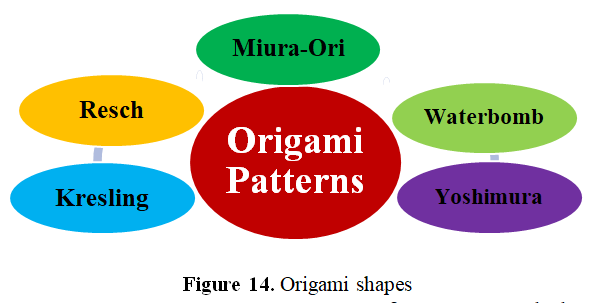
Abstract: Corrugations can be one of several methods to enhance the properties of thin-walled mechanical structures in terms of handling surface area. It is considered a solution to many application problems for devices and equipment and to solve engineering problems. This paper highlights the most famous origami shapes, manufacturing methods, and applications. The shapes of origami are dependent on the degree of freedom. This means that the shapes in this paper discussed the five most common types and the cell units they consist of. These units are repeated over the whole sheet. All shapes were drawn up with all their details or details of units that they were formed from. Also, it showed the single-cell unit that makes up each of the five most common patterns in engineering applications. The five most common patterns were waterbomb, Miura-Ori, Yoshimura, Kresling, and Resch. Owing to the ability of energy absorption and mechanical features, Miura-Ori was deeply discussed. For manufacturing processes, the most known methods were highlighted, which gave a hint for manufacturing differences in origami. In addition, the applications of origami in seven fields were presented in detail. The seven fields were automotive, aeroplan, aerospace, buildings and structures, biomedical engineering, map and floor plan, and architecture. Applications of origami in engineering have been extensively reviewed in fields such as the architecture field in the five specific disciplines. The five specific disciplines were building facades and adaptive shading systems, transformable vaults, bridge with load bearing capacity, transformable canopies, and sawtooth roofs. The objectives of the study are to make readers recognize the shapes of origami, to show the most important methods of manufacturing processes for origami, and to provide the applications in major origami-based engineering fields. In conclusion, this paper provides a significant reference for those interested in this matter or in the field of origami to obtain a wide and concise view of patterns, manufacturing processes, and applications of origami structures.
Article Details
Section

This work is licensed under a Creative Commons Attribution-NonCommercial-ShareAlike 4.0 International License.
Licensed under a CC-BY license: https://creativecommons.org/licenses/by-nc-sa/4.0/
How to Cite


References
T. Kanade, "A theory of origami world," Artificial intelligence, vol. 13, no. 3, pp. 279-311, 1980.
K. Liu, "Origami and tensegrity: structures and metamaterials," Georgia Institute of Technology, 2019.
X. Xiang, G. Lu, and Z. You, "Energy absorption of origami inspired structures and materials," Thin-Walled Structures, vol. 157, p. 107130, 2020.
F. Liu, T. Terakawa, S. Long, and M. Komori, "Rigid-foldable cylindrical origami with tunable mechanical behaviors," Scientific Reports, vol. 14, no. 1, p. 145, 2024.
S. Liu, G. Lu, Y. Chen, and Y. W. Leong, "Deformation of the Miura-ori patterned sheet," International Journal of Mechanical Sciences, vol. 99, pp. 130-142, 2015.
H. Al-Jothery and T. Albarody, "Study on Mechanical Behavior of Double Corrugation Surface Structure of Thermoset Composite," Journal of Engineering and Sustainable Development, vol. 29, no. 3, pp. 282-288, 2025.
N. Turner, B. Goodwine, and M. Sen, "A review of origami applications in mechanical engineering," Proceedings of the Institution of Mechanical Engineers, Part C: Journal of Mechanical Engineering Science, vol. 230, no. 14, pp. 2345-2362, 2016.
H. Y. Lee, "Origami-constructible numbers," University of Georgia, 2017.
Y. Nishiyama, "Miura folding: Applying origami to space exploration," International journal of pure and applied mathematics, vol. 79, no. 2, pp. 269-279, 2012.
J. Harris and G. McShane, "Metallic stacked origami cellular materials: Additive manufacturing, properties, and modelling," International Journal of Solids and Structures, vol. 185, pp. 448-466, 2020.
A. Hüseynli, "Geometric and Mobility Analysis of the Miura-Ori Pattern and Derivations," Izmir Institute of Technology (Turkey), 2016.
H. Al-Jothery, T. Albarody, P. Yusoff, M. Abdullah, A. Hussein, and M. Pahmi, "Crashworthiness design for trapezoid origami crash structure numerical," International Journal of Automotive and Mechanical Engineering, vol. 17, no. 1, pp. 7667-7674, 2020.
B. Kresling, "The fifth fold: complex symmetries in Kresling-origami patterns," Symmetry: Culture and Science, vol. 31, no. 4, pp. 403-416, 2020.
J.-E. Suh, T.-H. Kim, and J.-H. Han, "New approach to folding a thin-walled Yoshimura patterned cylinder," Journal of Spacecraft and Rockets, vol. 58, no. 2, pp. 516-530, 2021.
J. Ma, J. Song, and Y. Chen, "An origami-inspired structure with graded stiffness," International Journal of Mechanical Sciences, vol. 136, pp. 134-142, 2018.
L. Fei and D. Sujan, "Origami theory and its applications: a literature review," in Proceedings of world academy of science, engineering and technology, 2013, no. 73: World Academy of Science, Engineering and Technology (WASET), p. 1131.
P. Sareh and S. D. Guest, "A framework for the symmetric generalisation of the Miura-ori," International Journal of Space Structures, vol. 30, no. 2, pp. 141-152, 2015.
R. S. Karmakar, H.-F. Lin, J.-F. Huang, J.-I. Chao, Y.-C. Liao, and Y.-W. Lu, "A Multi-Layered Origami Tactile Sensory Ring for Wearable Biomechanical Monitoring," Biosensors, vol. 15, no. 1, p. 8, 2024.
J. O'Neil, "Origami manufacturing technique leads to breakthrough for softer impacts," 2024. [Online]. Available: https://www.aa.washington.edu/news/article/2024-04-03/origami-manufacturing-technique-softens-impact.
C. Chia and S. Debnath, "Origami and its Applications in Automotive Fie," CUTSE2009, 2009.
T. Hull, "In Search of a Practical Map Fold," Math Horizons, vol. 9, no. 3, pp. 22-24, 2002.
J. Ma and Z. You, "Modelling of the waterbomb origami pattern and its applications," in International Design Engineering Technical Conferences and Computers and Information in Engineering Conference, 2014, vol. 46377: American Society of Mechanical Engineers, p. V05BT08A047.
P. Sareh and S. D. Guest, "Design of non-isomorphic symmetric descendants of the Miura-ori," Smart Materials and Structures, vol. 24, no. 8, p. 085002, 2015.
Y. Lv, Y. Zhang, N. Gong, Z.-x. Li, G. Lu, and X. Xiang, "On the out-of-plane compression of a Miura-ori patterned sheet," International Journal of Mechanical Sciences, vol. 161, p. 105022, 2019.
M. Meloni et al., "Engineering origami: A comprehensive review of recent applications, design methods, and tools," Advanced Science, vol. 8, no. 13, p. 2000636, 2021.
A. R. Kamran, "Origami-Inspired Engineering: Math behind DONs," VFAST Transactions on Mathematics, vol. 11, no. 2, pp. 93-111, 2023.
X. Xiang et al., "The mechanical characteristics of graded Miura-ori metamaterials," Materials & Design, vol. 211, p. 110173, 2021.
C. Kunz, "Mathematics of Origami," 2024.
M. Schenk and S. D. Guest, "Geometry of Miura-folded metamaterials," Proceedings of the National Academy of Sciences, vol. 110, no. 9, pp. 3276-3281, 2013.
Y. Zhu, M. Schenk, and E. T. Filipov, "A review on origami simulations: from kinematics, to mechanics, toward multiphysics," Applied Mechanics Reviews, vol. 74, no. 3, p. 030801, 2022.
A. Qattawi, "Extending Origami technique to fold forming of sheet metal products," Clemson University, 2012.
I. Kusyairi and e. al, "Manufacture of Origami Pattern Crash Box Using Traditional," in International Conference on Mechanical Engineering Research and Application, 2019, p. 11.
J. Gattas and Z. You, "The behaviour of curved-crease foldcores under low-velocity impact loads," International Journal of Solids and Structures, vol. 53, pp. 80-91, 2015.
I. Kusyairi, H. M. Himawan, M. A. Choiron, and Y. S. Irawan, "Manufacture of Origami Pattern Crash Box Using Traditional Investment Casting Method," in IOP Conference Series: Materials Science and Engineering, 2019, vol. 494, no. 1: IOP Publishing, p. 012006.
S. Zhang, S. Yun, X. Sheng, J. Qin, G. Zhang, and X. Shi, "Facile manufacturing strategy for origami structure of thermoplastic elastomer foam with gradient stiffness by 3D printing," Additive Manufacturing, vol. 97, p. 104621, 2025.
T. R. Stevens and N. B. Crane, "Multiplanar manufacturing: A new approach to design for manufacturing and assembly of origami," Mechanism and Machine Theory, vol. 206, p. 105906, 2025.
S. Pattnaik, D. B. Karunakar, and P. K. Jha, "Developments in investment casting process—A review," Journal of Materials Processing Technology, vol. 212, no. 11, pp. 2332-2348, 2012.
A. A. Abtan, "Design and fabrication of origami elements for use in a folding robot structure," University of Leeds, 2019.
M. Schenk, J. Allwood, and S. Guest, "Cold gas-pressure folding of Miura-ori sheets," in Steel research international, special issue proceedings of the international conference on technology of plasticity (ICTP), 2011, vol. 201, no. 1, pp. 459-464.
J. O’Neil, M. Salviato, and J. Yang, "Energy absorption behavior of filament wound CFRP origami tubes pre-folded in Kresling pattern," Composite Structures, vol. 304, p. 116376, 2023.
M. Boreanaz, G. Belingardi, and C. D. F. Maia, "Application of the origami shape in the development of automotive crash box," Material Design & Processing Communications, vol. 2, no. 4, p. e181, 2020.
H. J. A. P. S. o. E. a. A. Sciences, "Designing a pop-up future," 2016. [Online]. Available: https://www.sciencedaily.com/releases/2016/01/160126175042.htm.
H. Liu, "Study on Miura Folding Technology and Its Application in
Sound Insultation," vol. Volume 75 (2023) 2023.
C. Zhou, Y. Zhou, and B. Wang, "Crashworthiness design for trapezoid origami crash boxes," Thin-Walled Structures, vol. 117, pp. 257-267, 2017.
Admin, "Into the Fold: How Origami is Helping to Solve Manufacturing Challenges," 2016. [Online]. Available: https://www.origamiengineering.net/2016/01/16/into-the-fold-how-origami-is-helping-to-solve-manufacturing-challenges/.
T. Kanade, "A theory of origami world," Artificial intelligence, vol. 13, no. 3, pp. 279-311, 1980.
K. Liu, "Origami and tensegrity: structures and metamaterials," Georgia Institute of Technology, 2019.
X. Xiang, G. Lu, and Z. You, "Energy absorption of origami inspired structures and materials," Thin-Walled Structures, vol. 157, p. 107130, 2020.
F. Liu, T. Terakawa, S. Long, and M. Komori, "Rigid-foldable cylindrical origami with tunable mechanical behaviors," Scientific Reports, vol. 14, no. 1, p. 145, 2024.
S. Liu, G. Lu, Y. Chen, and Y. W. Leong, "Deformation of the Miura-ori patterned sheet," International Journal of Mechanical Sciences, vol. 99, pp. 130-142, 2015.
H. Al-Jothery and T. Albarody, "Study on Mechanical Behavior of Double Corrugation Surface Structure of Thermoset Composite," Journal of Engineering and Sustainable Development, vol. 29, no. 3, pp. 282-288, 2025.
N. Turner, B. Goodwine, and M. Sen, "A review of origami applications in mechanical engineering," Proceedings of the Institution of Mechanical Engineers, Part C: Journal of Mechanical Engineering Science, vol. 230, no. 14, pp. 2345-2362, 2016.
H. Y. Lee, "Origami-constructible numbers," University of Georgia, 2017.
Y. Nishiyama, "Miura folding: Applying origami to space exploration," International journal of pure and applied mathematics, vol. 79, no. 2, pp. 269-279, 2012.
J. Harris and G. McShane, "Metallic stacked origami cellular materials: Additive manufacturing, properties, and modelling," International Journal of Solids and Structures, vol. 185, pp. 448-466, 2020.
A. Hüseynli, "Geometric and Mobility Analysis of the Miura-Ori Pattern and Derivations," Izmir Institute of Technology (Turkey), 2016.
H. Al-Jothery, T. Albarody, P. Yusoff, M. Abdullah, A. Hussein, and M. Pahmi, "Crashworthiness design for trapezoid origami crash structure numerical," International Journal of Automotive and Mechanical Engineering, vol. 17, no. 1, pp. 7667-7674, 2020.
B. Kresling, "The fifth fold: complex symmetries in Kresling-origami patterns," Symmetry: Culture and Science, vol. 31, no. 4, pp. 403-416, 2020.
J.-E. Suh, T.-H. Kim, and J.-H. Han, "New approach to folding a thin-walled Yoshimura patterned cylinder," Journal of Spacecraft and Rockets, vol. 58, no. 2, pp. 516-530, 2021.
J. Ma, J. Song, and Y. Chen, "An origami-inspired structure with graded stiffness," International Journal of Mechanical Sciences, vol. 136, pp. 134-142, 2018.
L. Fei and D. Sujan, "Origami theory and its applications: a literature review," in Proceedings of world academy of science, engineering and technology, 2013, no. 73: World Academy of Science, Engineering and Technology (WASET), p. 1131.
P. Sareh and S. D. Guest, "A framework for the symmetric generalisation of the Miura-ori," International Journal of Space Structures, vol. 30, no. 2, pp. 141-152, 2015.
R. S. Karmakar, H.-F. Lin, J.-F. Huang, J.-I. Chao, Y.-C. Liao, and Y.-W. Lu, "A Multi-Layered Origami Tactile Sensory Ring for Wearable Biomechanical Monitoring," Biosensors, vol. 15, no. 1, p. 8, 2024.
J. O'Neil, "Origami manufacturing technique leads to breakthrough for softer impacts," 2024. [Online]. Available: https://www.aa.washington.edu/news/article/2024-04-03/origami-manufacturing-technique-softens-impact.
C. Chia and S. Debnath, "Origami and its Applications in Automotive Fie," CUTSE2009, 2009.
T. Hull, "In Search of a Practical Map Fold," Math Horizons, vol. 9, no. 3, pp. 22-24, 2002.
J. Ma and Z. You, "Modelling of the waterbomb origami pattern and its applications," in International Design Engineering Technical Conferences and Computers and Information in Engineering Conference, 2014, vol. 46377: American Society of Mechanical Engineers, p. V05BT08A047.
P. Sareh and S. D. Guest, "Design of non-isomorphic symmetric descendants of the Miura-ori," Smart Materials and Structures, vol. 24, no. 8, p. 085002, 2015.
Y. Lv, Y. Zhang, N. Gong, Z.-x. Li, G. Lu, and X. Xiang, "On the out-of-plane compression of a Miura-ori patterned sheet," International Journal of Mechanical Sciences, vol. 161, p. 105022, 2019.
M. Meloni et al., "Engineering origami: A comprehensive review of recent applications, design methods, and tools," Advanced Science, vol. 8, no. 13, p. 2000636, 2021.
A. R. Kamran, "Origami-Inspired Engineering: Math behind DONs," VFAST Transactions on Mathematics, vol. 11, no. 2, pp. 93-111, 2023.
X. Xiang et al., "The mechanical characteristics of graded Miura-ori metamaterials," Materials & Design, vol. 211, p. 110173, 2021.
C. Kunz, "Mathematics of Origami," 2024.
M. Schenk and S. D. Guest, "Geometry of Miura-folded metamaterials," Proceedings of the National Academy of Sciences, vol. 110, no. 9, pp. 3276-3281, 2013.
Y. Zhu, M. Schenk, and E. T. Filipov, "A review on origami simulations: from kinematics, to mechanics, toward multiphysics," Applied Mechanics Reviews, vol. 74, no. 3, p. 030801, 2022.
A. Qattawi, "Extending Origami technique to fold forming of sheet metal products," Clemson University, 2012.
I. Kusyairi and e. al, "Manufacture of Origami Pattern Crash Box Using Traditional," in International Conference on Mechanical Engineering Research and Application, 2019, p. 11.
J. Gattas and Z. You, "The behaviour of curved-crease foldcores under low-velocity impact loads," International Journal of Solids and Structures, vol. 53, pp. 80-91, 2015.
I. Kusyairi, H. M. Himawan, M. A. Choiron, and Y. S. Irawan, "Manufacture of Origami Pattern Crash Box Using Traditional Investment Casting Method," in IOP Conference Series: Materials Science and Engineering, 2019, vol. 494, no. 1: IOP Publishing, p. 012006.
S. Zhang, S. Yun, X. Sheng, J. Qin, G. Zhang, and X. Shi, "Facile manufacturing strategy for origami structure of thermoplastic elastomer foam with gradient stiffness by 3D printing," Additive Manufacturing, vol. 97, p. 104621, 2025.
T. R. Stevens and N. B. Crane, "Multiplanar manufacturing: A new approach to design for manufacturing and assembly of origami," Mechanism and Machine Theory, vol. 206, p. 105906, 2025.
S. Pattnaik, D. B. Karunakar, and P. K. Jha, "Developments in investment casting process—A review," Journal of Materials Processing Technology, vol. 212, no. 11, pp. 2332-2348, 2012.
A. A. Abtan, "Design and fabrication of origami elements for use in a folding robot structure," University of Leeds, 2019.
M. Schenk, J. Allwood, and S. Guest, "Cold gas-pressure folding of Miura-ori sheets," in Steel research international, special issue proceedings of the international conference on technology of plasticity (ICTP), 2011, vol. 201, no. 1, pp. 459-464.
J. O’Neil, M. Salviato, and J. Yang, "Energy absorption behavior of filament wound CFRP origami tubes pre-folded in Kresling pattern," Composite Structures, vol. 304, p. 116376, 2023.
M. Boreanaz, G. Belingardi, and C. D. F. Maia, "Application of the origami shape in the development of automotive crash box," Material Design & Processing Communications, vol. 2, no. 4, p. e181, 2020.
H. J. A. P. S. o. E. a. A. Sciences, "Designing a pop-up future," 2016. [Online]. Available: https://www.sciencedaily.com/releases/2016/01/160126175042.htm.
H. Liu, "Study on Miura Folding Technology and Its Application in
Sound Insultation," vol. Volume 75 (2023) 2023.
C. Zhou, Y. Zhou, and B. Wang, "Crashworthiness design for trapezoid origami crash boxes," Thin-Walled Structures, vol. 117, pp. 257-267, 2017.
Admin, "Into the Fold: How Origami is Helping to Solve Manufacturing Challenges," 2016. [Online]. Available: https://www.origamiengineering.net/2016/01/16/into-the-fold-how-origami-is-helping-to-solve-manufacturing-challenges/.
M. A. Wagner, J.-L. Huang, P. Okle, J. Paik, and R. Spolenak, "Hinges for origami-inspired structures by multimaterial additive manufacturing," Materials & Design, vol. 191, p. 108643, 2020.
L. Santos Lula Barros et al., "Evaluation of Folding-Pattern Designs for Large-Scale Square Solar Sail."
M. Yang, J. Defillion, F. Scarpa, and M. Schenk, "Volume optimisation of multi-stable origami bellows for deployable space habitats," Acta Mechanica Solida Sinica, vol. 36, no. 4, pp. 514-530, 2023.
M. Tsiamis, A. Oliva, and M. Calvano, "Algorithmic design and analysis of architectural origami," Nexus Network Journal, vol. 20, no. 1, pp. 59-73, 2018.
P. Sareh and S. D. Guest, "Designing symmetric derivatives of the Miura-ori," in Advances in Architectural Geometry 2014: Springer, 2014, pp. 233-241.
R. M. Pavón et al., "New use of BIM-origami-based techniques for energy optimisation of buildings," Applied Sciences, vol. 12, no. 3, p. 1496, 2022.
P. M. Reisa, F. L. Jiméneza, and J. Marthelota, "Transforming architectures inspired by origami" vol. 112, 2015. [Online]. Available: https://www.epfl.ch/labs/flexlab/wp-content/uploads/2017/12/55_2015_Reis_PNAS_TransformingArchitecturesOrigami.pdf.
J. Peren, T. Van Hooff, R. Ramponi, B. Blocken, and B. C. C. Leite, "Impact of roof geometry of an isolated leeward sawtooth roof building on cross-ventilation: Straight, concave, hybrid or convex?," Journal of Wind Engineering and Industrial Aerodynamics, vol. 145, pp. 102-114, 2015.