
Pressure Drop Analysis Using Deep Learning Techniques to Enhance Micro-channel Cooling Performance in Energy Conversion Systems
Article Sidebar
Main Article Content
Abstract
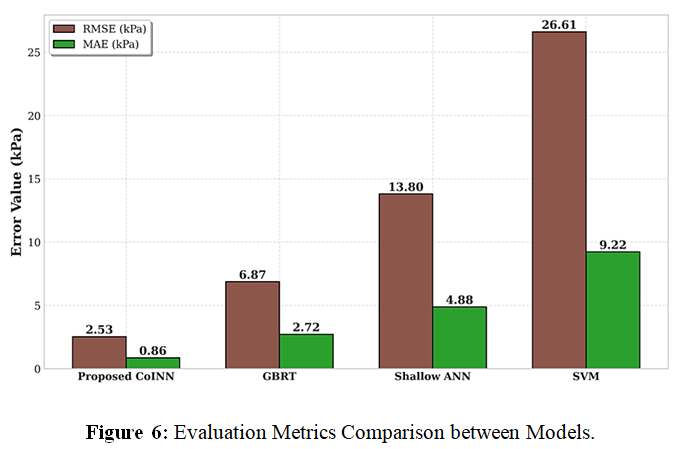
The high power energy conversion systems are quickly increasing in power, which requires a great deal of efficiency in thermal management, and micro-channel heat sinks have found considerable use in this area. But it is computationally expensive and time consuming to determine the pressure drop in these complicated micro-geometries accurately by using the conventional experimental or computational fluid dynamics methodology. In a bid to overcome this critical issue, this work suggests a new deep learning model, which is referred to as the Channel-Inspired Neural Network (CoINN), which is specially designed to identify pressure drop in the variety of micro-channel arrangements. A large dataset was created and described that was based on physics, and it included different operational fluid dynamics and geometric parameters. CoINN model was trained and strictly benchmarked against known machine learning baseline models, such as Gradient Boosted Regression Trees, shallow Artificial Neural Network, and Support Vector machine. The CoINN framework has been shown by quantitative analysis to be absolutely superior with a Coefficient of Determination of 0.9998 and a Mean Absolute Error of only 0.859 kPa which means that CoINN would compare with the traditional algorithms that would have trouble with the non-linearities inherent with the fluid data. Moreover, systematic sensitivity analysis confirmed the physical interpretability of the deep learning model and accurately found the two key physical mechanisms governing the pressure drop due to frictional inlet velocity and hydraulic diameter. The suggested framework offers a very robust, predictive surrogate model, which is accurate and computationally fast, and it opens the way to faster design and optimization of advanced micro-scale cooling technologies.
Article Details
Section

This work is licensed under a Creative Commons Attribution-NonCommercial-ShareAlike 4.0 International License.
Licensed under a CC-BY license: https://creativecommons.org/licenses/by-nc-sa/4.0/
How to Cite


References
Sun, B., & Huang, X. (2021). Seeking advanced thermal management for stretchable electronics. npj Flexible Electronics, 5(1), 12.
Gao, J., Hu, Z., Yang, Q., Liang, X., & Wu, H. (2022). Fluid flow and heat transfer in microchannel heat sinks: Modelling review and recent progress. Thermal Science and Engineering Progress, 29, 101203.
Pontes, P., Gonçalves, I., Andredaki, M., Georgoulas, A., Moreira, A. L. N., & Moita, A. S. (2023). Fluid flow and heat transfer in microchannel devices for cooling applications: Experimental and numerical approaches. Applied Thermal Engineering, 218, 119358.
Harris, M., Wu, H., Zhang, W., & Angelopoulou, A. (2022). Overview of recent trends in microchannels for heat transfer and thermal management applications. Chemical Engineering and Processing-Process Intensification, 181, 109155.
Balasubramanian, K., Lee, P. S., Jin, L. W., Chou, S. K., Teo, C. J., & Gao, S. (2011). Experimental investigations of flow boiling heat transfer and pressure drop in straight and expanding microchannels–a comparative study. International Journal of Thermal Sciences, 50(12), 2413-2421.
Jawad, D. A. A. H., & Ahmed, S. S. (2024, October). Effect of Microchannel Geometry on Thermal Performance of Microchannel Heatsinks: A CFD Study. In Defect and Diffusion Forum (Vol. 436, pp. 53-65). Trans Tech Publications Ltd.
Kochkov, D., Smith, J. A., Alieva, A., Wang, Q., Brenner, M. P., & Hoyer, S. (2021). Machine learning–accelerated computational fluid dynamics. Proceedings of the National Academy of Sciences, 118(21), e2101784118.
Kochkov, D., Smith, J. A., Alieva, A., Wang, Q., Brenner, M. P., & Hoyer, S. (2021). Machine learning–accelerated computational fluid dynamics. Proceedings of the National Academy of Sciences, 118(21), e2101784118.
Abidi, A., Ahmadi, A., Enayati, M., Sajadi, S. M., Yarmand, H., Ahmed, A., & Cheraghian, G. (2021). A review of the methods of modeling multi-phase flows within different microchannels shapes and their applications. Micromachines, 12(9), 1113.
Hao, P. F., He, F., & Zhu, K. Q. (2005). Flow characteristics in a trapezoidal silicon microchannel. Journal of Micromechanics and Microengineering, 15(6), 1362.
Ran, S., Zhang, P., & Rao, Y. (2022). Numerical study of heat transfer and flow structure over channel surfaces featuring miniature V rib-dimples with various configurations. International Journal of Thermal Sciences, 172, 107342.
Ismail, O. A., Ali, A. M., Hassan, M. A., & Gamea, O. (2023). Geometric optimization of pin fins for enhanced cooling in a microchannel heat sink. International Journal of Thermal Sciences, 190, 108321.
Mukhtar, A., Yasir, A. S. H. M., & Nasir, M. F. M. (2023). A machine learning-based comparative analysis of surrogate models for design optimisation in computational fluid dynamics. Heliyon, 9(8).
Ghahdarijani, A. M., Hormozi, F., & Asl, A. H. (2017). Convective heat transfer and pressure drop study on nanofluids in double-walled reactor by developing an optimal multilayer perceptron artificial neural network. International Communications in Heat and Mass Transfer, 84, 11-19.
Do Nascimento, C. A. R., Mariani, V. C., & dos Santos Coelho, L. (2020). Integrative numerical modeling and thermodynamic optimal design of counter-flow plate-fin heat exchanger applying neural networks. International Journal of Heat and Mass Transfer, 159, 120097.
Shillan, D., Sterne, J. A., Champneys, A., & Gibbison, B. (2019). Use of machine learning to analyse routinely collected intensive care unit data: a systematic review. Critical care, 23, 1-11.
Sun, G., Wang, J., Cai, W., Shi, L., Yao, B., & Yang, F. (2025). A Blending Model for Predicting Flow Rate of Crude Oil Pipeline by Integrating Leapienzon Friction Formula with Random Forest Algorithm. Flow Measurement and Instrumentation, 102971.
Moradkhani, M. A., Hosseini, S. H., Song, M., & Abbaszadeh, A. (2024). Reliable smart models for estimating frictional pressure drop in two-phase condensation through smooth channels of varying sizes. Scientific Reports, 14(1), 10515.
Baig, R. U., Javed, S., Khaisar, M., Shakoor, M., & Raja, P. (2021). Development of an ANN model for prediction of tool wear in turning EN9 and EN24 steel alloy. Advances in Mechanical Engineering, 13(6), 16878140211026720.
Raissi, M., Perdikaris, P., & Karniadakis, G. E. (2019). Physics-informed neural networks: A deep learning framework for solving forward and inverse problems involving nonlinear partial differential equations. Journal of Computational physics, 378, 686-707.
Qiu, Y., Vo, T., Garg, D., Lee, H., & Kharangate, C. R. (2023). A systematic approach to optimization of ANN model parameters to predict flow boiling heat transfer coefficient in mini/micro-channel heatsinks. International Journal of Heat and Mass Transfer, 202, 123728.
Ismail, O. A., Ali, A. M., Hassan, M. A., & Gamea, O. (2023). Geometric optimization of pin fins for enhanced cooling in a microchannel heat sink. International Journal of Thermal Sciences, 190, 108321.
Montañez-Barrera, J. A., Barroso-Maldonado, J. M., Bedoya-Santacruz, A. F., & Mota-Babiloni, A. (2022). Correlated-informed neural networks: a new machine learning framework to predict pressure drop in micro-channels. International Journal of Heat and Mass Transfer, 194, 123017.