
A Review of Machine Learning Classifiers for Feature-Based Image Forgery Detection
Article Sidebar
Main Article Content
Abstract
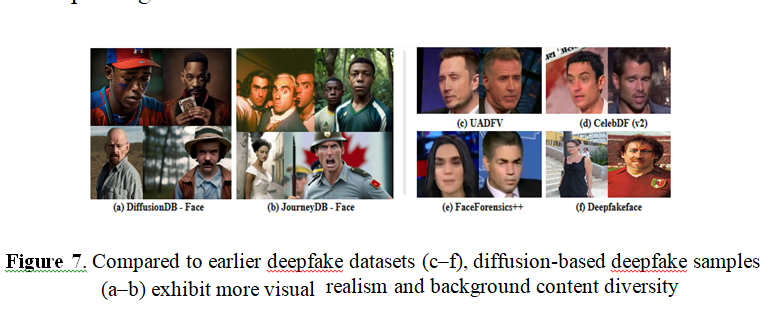
The increasing use of digital image manipulation and the generation of synthetic images has led to serious concerns regarding the authenticity and trustworthiness of images. The recent development of advanced generative models like StyleGAN, StyleGAN2, and diffusion models has the potential to generate very realistic synthetic images that are very difficult to distinguish from real images, thus leading to serious challenges in digital image forensics. This paper presents a comprehensive review of image forgery detection techniques with a primary focus on machine learning-based techniques. Various image forgery techniques, including traditional image forgery and AI-created synthetic images, are presented to understand their nature and challenges in image forgery detection. The paper presents a review of machine learning-based methods, popular datasets, and evaluation metrics for image forgery detection. Furthermore, the paper presents the challenges of existing methods, particularly their poor generalization capability for diffusion-based forgeries and the lack of representative benchmarks, and concludes with open challenges and future research avenues for developing generalized machine learning methods for authentic detection of image forgeries.
Article Details
Section

This work is licensed under a Creative Commons Attribution-NonCommercial-ShareAlike 4.0 International License.
Licensed under a CC-BY license: https://creativecommons.org/licenses/by-nc-sa/4.0/
How to Cite


References
A. F. H. Sewan and M. S. M. Altaei, "Copy Move Forgery Detection Using Forensic Image," Iraqi Journal of Science, vol. 62, no. 9, pp. 3167-3181, 2021.
L. D. Griffin, M. Caldwell, J. T. A. Andrews, and H. Bohler, "Unexpected item in the bagging area”: Anomaly detection in X-ray security images," IEEE Transactions on Information Forensics and Security, vol. 14, no. 6, pp. 1539-1553, June 2019, doi: 10.1109/TIFS.2018.2881700.
M. Vafadar and H. Ghassemian, "Hyperspectral anomaly detection using combined similarity criteria," IEEE Journal of Selected Topics in Applied Earth Observations and Remote Sensing, vol. 11, no. 11, pp. 4076-4085, 2018.
M. Ning, P. Yu, W. Shaojun and G. Wei, "A weight SAE based hyperspectral image anomaly targets detection," in 2017 13th IEEE International Conference on Electronic Measurement & Instruments (ICEMI), 2017, pp. 511-515.
M. G. Alex, C. Rajalakshmi, and R. Balasubramanian, "Study of image tampering and review of tampering detection techniques," International Journal of Advanced Research in Computer Science, vol. 8, no. 7, pp. 963-967, 2017.
H. Farid, "Image forgery detection," IEEE Signal processing magazine, vol. 26, no. 2, pp. 16-25, 2009.
P. Korus, "Digital image integrity–a survey of protection and verification techniques," Digital Signal Processing, vol. 71, no. 2017, pp. 1-26, 2017.
S. Ozturk and E. Gul, "A novel hash function based fragile watermarking method for image integrity," Multimedia Tools and Applications, vol. 78, no. 13, pp. 17701-17718, 2019.
Z. Zhang, Y. Ren, X. Ping, Z. He and S. Zhang, "A survey on passive-blind image forgery by doctor method detection," in 2008 international conference on machine learning and cybernetics, 2008, pp. 3463-3467.
Li, L., Bao, J., Yang, H., Chen, D., & Wen, F. (2020). Advancing high fidelity identity swapping for forgery detection. In Proceedings of the IEEE/CVF conference on computer vision and pattern recognition (pp. 5074–5083).
Bai, R. (2025). Weakly-Supervised Cross-Contrastive Learning Network for Image Manipulation Detection and Localization. Available at: ScienceDirect.
Chen, W., Zhang, C., & Xu, B. (2023). Hybrid CNN-ViT Model for Image Forgery Detection. Neural Information Processing Systems (NeurIPS).
Chaudhuri, A., Bhunia, A. K. (2024). Self-Supervised Learning for Robust Forgery Detection Models. IEEE International Conference on Computer Vision (ICCV).
Dixit, A., Sharma, S. K., & Dhaka, M. (2024). Image and Video Retrieval and Authentication using AI-Driven Techniques for Secure Media Management. ICTACT Journal on Image and Video Processing.
Duan, H., Jiang, Q., Xu, X. (2025). Adversarial Samples Generated by Self-Forgery for Face Forgery Detection. IEEE Transactions on Pattern Analysis and Machine Intelligence (TPAMI).
Gaikwad, S., & Mizwan, Z. (2025). Detection of Image Forgery using Deep Learning. Available at: AIP.
Gonzalez, S., & Tapia, J. E. (2025). Forged Presentation Attack Detection for ID Cards on Remote Verification Systems. Available at: ScienceDirect.
Goodfellow, I., Pouget-Abadie, J., Mirza, M., Xu, B., Warde-Farley, D., Ozair, S., & Courville, A. (2014). Generative Adversarial Nets. Advances in Neural Information Processing Systems (NeurIPS).
Han, R., Wang, X., Bai, N. (2024). HDF-Net: Capturing Homogeny Difference Features to Localize the Tampered Image. IEEE Transactions on Machine Intelligence.
He, K., Zhang, X., Ren, S., & Sun, J. (2016). Deep Residual Learning for Image Recognition. Proceedings of the IEEE Conference on Computer Vision and Pattern Recognition (CVPR).
Zahra, Hamid.A.Jalab & Rafidah Md. Noor (2019). Image splicing forgery detection based on low-dimensional singular value decomposition of discrete cosine transform coefficients. Neural Computing and application 31(1)
Jin, X., Wozniak, M., Duan, H., Jiang, Q. (2025). Mf-net: Multi-Feature Fusion Network Based on Two-Stream Extraction and Multi-Scale Enhancement for Face Forgery Detection. Springer Complex & Intelligent Systems.
Khalaf, L. I., Jumaili, M. L. F., & Mahmood, M. T. (2025). Image Forgery Detection using Convolutional Neural Networks and Blockchain Technology. Available at: ACM.
Kim, H., & Park, J. (2024). Improving Generalization in Image Forgery Detection with Adversarial Training. IEEE Transactions on Artificial Intelligence (TAI).
Liu, R., Zhang, S., Xu, Y. (2025). High-Resolution Network-Based MultiFeature Fusion for Generalized Forgery Detection. Multimedia Systems, Springer. Link
Liang, H., Leng, Y., Luo, J. (2024). A Face Forgery Video Detection Model Based on Knowledge Distillation. IEEE Transactions on Artificial Intelligence (TAI). Link
Goodfellow, I.J.; Pouget-Abadie, J.; Mirza, M.; Xu, B.; Warde-Farley, D.; Ozair, S.; Courville, A.C.; Bengio, Y. Generative adversarial networks. Commun. ACM 2020, 63, 139–144.
Wang, X.; Guo, H.; Hu, S.; Chang, M.C.; Lyu, S. Gan-generated faces detection: A survey and new perspectives. arXiv 2022, arXiv:2202.07145.
Natsume, R.; Yatagawa, T.; Morishima, S. RSGAN: Face swapping and editing using face and hair representation in latent spaces. arXiv 2018, arXiv:1804.03447.
Choi, Y.; Choi, M.; Kim, M.; Ha, J.W.; Kim, S.; Choo, J. StarGAN: Unified generative adversarial networks for multi-domain image-to-image translation. In Proceedings of the 2018 IEEE/CVF Conference on Computer Vision and Pattern Recognition (CVPR), Salt Lake City, UT, USA, 18–23 June 2018; pp. 8789–8797.
Pumarola, A.; Agudo, A.; Martinez, A.M.; Sanfeliu, A.; Moreno-Noguer, F. GANimation: One-shot anatomically consistent facial animation. Int. J. Comput. Vis. 2020, 128, 698–713.
Karras, T.; Aila, T.; Laine, S.; Lehtinen, J. Progressive Growing of GANs for Improved Quality, Stability, and Variation. In ICLR 2018, Vancouver, BC, Canada, 30 April–3 May 2018.
Donahue, J.; Krähenbühl, P.; Darrell, T. Adversarial feature learning. arXiv 2016, arXiv:1605.09782.
Carrara, F.; Amato, G.; Brombin, L.; Falchi, F.; Gennaro, C. Combining GANs and autoencoders for efficient anomaly detection. In Proceedings of the 2020 25th International Conference on Pattern Recognition (ICPR), Milan, Italy, 10–15 January 2021; pp. 3939–3946.
Arjovsky, M.; Chintala, S.; Bottou, L. Wasserstein Generative Adversarial Networks. In Proceedings of the 34th International Conference on Machine Learning, Sydney, NSW, Australia, 6–11 August 2017; Volume 70, pp. 214–223.
Chaudhari, P.; Agrawal, H.; Kotecha, K. Data augmentation using MG-GAN for improved cancer classification on gene expression data. Soft Comput. 2020, 24, 11381–11391.
Schuhmann, C., Beaumont, R., Vencu, R., Gordon, C., Wightman, R., Cherti, M., Coombes, T., Katta, A., Mullis, C., Wortsman, M., Schramowski, P., Kundurthy, S., Crowson, K., Schmidt, L., Kaczmarczyk, R., Jitsev, J.: Laion-5b: An open large-scale dataset for training next generation image-text models. vol. 35, pp. 25278–25294. Curran Associates, Inc. (2022).
Stability ai. https://stability.ai/
Midjourney discord server. https://discord.com/invite/midjourney
Rossler, A., Cozzolino, D., Verdoliva, L., Riess, C., Thies, J., Nießner, M.: Faceforensics++: Learning to detect manipulated facial images. In: ICCV. pp. 1–11 (2019) Supplementary Material.
Li, Y., Yang, X., Sun, P., Qi, H., Lyu, S.: Celeb-df: A large-scale challenging datasetfor deepfake forensics. In: CVPR (2020)
Yan, Z., Zhang, Y., Yuan, X., Lyu, S., Wu, B.: Deepfakebench: A comprehensivebenchmark of deepfake detection. In: Thirty-seventh Conference on Neural Information Processing Systems Datasets and Benchmarks Track (2023)
Cozzolino, D., Thies, J., Ro¨ssler, A., Riess, C., Nießner, M., Verdoliva, L.: Forensictransfer: Weakly-supervised domain adaptation for forgery detection. arXiv preprint arXiv:1812.02510 (2018).
Aneja, S., Nießner, M.: Generalized zero and few-shot transfer for facial forgerydetection. arXiv preprint arXiv:2006.11863 (2020).
C. Bhattacharyya, H. Wang, F. Zhang, S. Kim, and X. Zhu, “Diffusion Deepfake,” arXiv:2404.01579v1 [cs.CV], Apr. 2024. doi: 10.48550/arXiv.2404.01579.
Moghaddasi, Z., Jalab, H. A., & Noor, R. M. (2018). Image splicing forgery detection based on low-dimensional singular value decomposition of discrete cosine transform coefficients. Neural Comput. Appl. 31(11), 7867–7877.
Zhu, Y., Li, Q., Wang, J., Xu, C. Z., & Sun, Z. (2021). One shot face swapping on megapixels. In Proceedings of the IEEE/CVF conference on computer vision and pattern recognition (pp. 4834–4844).
Zhang, Q. et al. "Digital image splicing detection based on Markov features in block DWT domain", Multimedia Tools and Applications, vol. 77, no 23, DODOI10.1007/s11042-018, 2018.
A. K. Jaiswal, and R. Srivastava, "A technique for image splicing detection using hybrid feature set," Multimedia Tools and Applications, vol. 79, no. 17, pp. 11837-11860, 2020.
M. Habibi and H. Hassanpour, "Splicing image forgery detection and localization based on color," International Journal of Engineering, vol. 34, no. 2, pp. 443-451, 2021.
A. Parnak, Y. D. Baleghi and . S. Kazemitabar, "A Novel Image Splicing Detection Algorithm Based on Generalized and Traditional Benford’s Law," International Journal of Engineering, vol. 35, no. 4, pp. 626-634, 2022.
S. Solaiyappan and . Y. Wen, "Machine learning based medical image deep fake detection: A comparative study, Machine Learning with Applications, vol. 8, no. 2, pp. 2666-8270, 2022.
M. R. Archana, D. Jamkhandikar, and D. N. Biradar, “Image copy-move forgery detection and classification using golden jackal optimization based multi-support vector machine,” International Journal of Intelligent Engineering and Systems, vol. 16, no. 6, pp. 123–133, 2023, doi: 10.22266/ijies2023.1231.11.
J. D. Norman and H. Farid, “Detecting Deepfake Talking Heads from Facial Biometric Anomalies,” arXiv preprint arXiv:2507.08917, Jul. 2025, doi: 10.48550/arXiv.2507.08917.
A. Singh, A. Bansal, N. Chauhan, and S. P. Sahu, “Image generation using GAN and its classification using SVM and CNN,” in Proceedings of Emerging Trends and Technologies on Intelligent Systems, Advances in Intelligent Systems and Computing, vol. 1365, Singapore: Springer, 2022, pp. 89–100, doi:10.1007/978-981-16-3097-2_8.