
Measuring Structural Environmental Awareness in Iraqi Architecture through AHP and Climatic Analysis
Article Sidebar
Main Article Content
Abstract
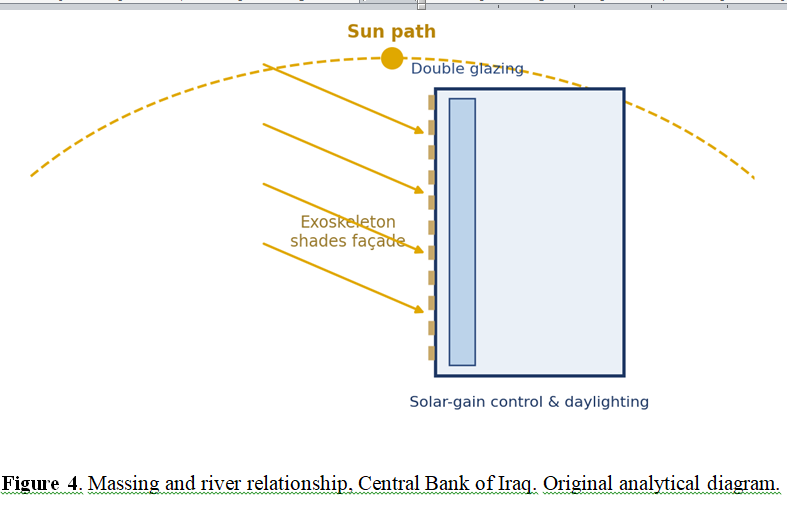
In many cases, the quality of the environment in Iraqi architecture is judged from the formal reading and the presence of what is inherited from the vocabulary is considered evidence of awareness of the environment. In this paper, an alternative criterion, structural criterion, is proposed and made measurable. The five criteria: Passive Climatic Response, Contextual and Urban Integration, Environmental Perception, Material and Resource Logic, and Structural Integration of Environmental Function are weighted using Analytic Hierarchy Process (AHP) and based on the solar geometry of Baghdad (33.3° N) for the development of a Structural Environmental Awareness Index (SEAI). Using the normalised geometric mean, the criterion weights were obtained from a reciprocal matrix with a consistency ratio of CR = 0.008. The building evidence is rated on a five-level evidence scale and added together to form an index with a 0–100 scale. It's used on two buildings in Baghdad, which respond to the same climate in different ways, and on opposite principles, fifty years apart: the Central Post Office by Rifat Chadirji (1975), which blocks the radiation but lets the diffuse light and air through, and the Central Bank of Iraq by Zaha Hadid Architects, which shades the glazing and carries the load with its structural exoskeleton. The Post Office obtained SEAI = 95.4 and the Central Bank SEAI = 85.9, which was maintained in all ten weight perturbations and under equal weights. On structural integration, the two works get the same score, which means that the screen and the exoskeleton are structurally similar and that environmental awareness is a structural principle and not a period style. This margin is primarily on material and resource logic, when structure, mass and enclosure is released simultaneously by means of load-bearing masonry. The numerical values are a demonstration of the instrument and need to be confirmed by the expert elicitation and dynamic simulation before making inferential claims.
Article Details
Section

This work is licensed under a Creative Commons Attribution-NonCommercial-ShareAlike 4.0 International License.
Licensed under a CC-BY license: https://creativecommons.org/licenses/by-nc-sa/4.0/
How to Cite


References
[1] Saaty, T. L. (1980). The Analytic Hierarchy Process. New York: McGraw-Hill.
[2] Wong, J. K. W., & Li, H. (2008). Application of the analytic hierarchy process (AHP) in multi-criteria analysis of the selection of intelligent building systems. Building and Environment, 43(1), 108–125.
[3] Harputlugil, T. (2018). Analytic Hierarchy Process (AHP) as an assessment approach for architectural design: Case study of an architectural design studio. ICONARP International Journal of Architecture and Planning, 6(2), 217–245.
[4] Olgyay, V. (1963). Design with Climate: Bioclimatic Approach to Architectural Regionalism. Princeton: Princeton University Press.
[5] McHarg, I. L. (1969). Design with Nature. Garden City, NY: Natural History Press.
[6] U.S. Green Building Council. (2019). LEED v4.1 Building Design and Construction. Washington, DC: USGBC.
[7] Building Research Establishment. (2016). BREEAM International New Construction: Technical Manual. Watford: BRE Global.
[8] International Organization for Standardization. (2006). ISO 14040: Environmental management — Life cycle assessment — Principles and framework. Geneva: ISO.
[9] International Organization for Standardization. (2006). ISO 14044: Environmental management — Life cycle assessment — Requirements and guidelines. Geneva: ISO.
[10] Francis, A., Padmanabhan, V., & Thomas, A. (2024). A life-cycle-assessment-based case study analysis of the sustainability of vernacular versus contemporary construction techniques. Engineering, Construction and Architectural Management, 32(9).
[11] de Dear, R., & Brager, G. S. (1998). Developing an adaptive model of thermal comfort and preference. ASHRAE Transactions, 104, 145–167.
[12] ASHRAE. (2023). ANSI/ASHRAE Standard 55: Thermal Environmental Conditions for Human Occupancy. Atlanta: ASHRAE.
[13] Fathy, H. (1973). Architecture for the Poor: An Experiment in Rural Egypt. Chicago: University of Chicago Press.
[14] Fathy, H. (1986). Natural Energy and Vernacular Architecture: Principles and Examples with Reference to Hot Arid Climates. Chicago: University of Chicago Press.
[15] Al-Hafith, O., Satish, B. K., Bradbury, S., & de Wilde, P. (2017). The impact of courtyard parameters on its shading level: An experimental study in Baghdad, Iraq. Energy Procedia, 134, 99–109.
[16] Khan, H. M. (2015). Modelling and Thermal Optimization of Traditional Housing in a Hot Arid Area. PhD thesis, University of Manchester.
[17] Al-Hemiddi, N. A., & Megren Al-Saud, K. A. (2001). The effect of a ventilated interior courtyard on the thermal performance of a house in a hot–arid region. Renewable Energy, 24(3–4), 581–595.
[18] Al-Masri, N., & Abu-Hijleh, B. (2012). Courtyard housing in midrise buildings: An environmental assessment in hot-arid climate. Renewable and Sustainable Energy Reviews, 16(4), 1892–1898.
[19] Frampton, K. (1983). Towards a critical regionalism: Six points for an architecture of resistance. In H. Foster (Ed.), The Anti-Aesthetic: Essays on Postmodern Culture (pp. 16–30). Port Townsend, WA: Bay Press.
[20] Norberg-Schulz, C. (1980). Genius Loci: Towards a Phenomenology of Architecture. New York: Rizzoli.
[21] Chadirji, R. (1986). Al-Ukhaidir and the Crystal Palace [in Arabic]. [Publisher and place of publication to be confirmed from the edition used.]
[22] Ittelson, W. H., Proshansky, H. M., Rivlin, L. G., & Winkel, G. H. (1974). An Introduction to Environmental Psychology. New York: Holt, Rinehart and Winston.
[23] Lynch, K. (1960). The Image of the City. Cambridge, MA: MIT Press.
[24] Rapoport, A. (1977). Human Aspects of Urban Form: Towards a Man–Environment Approach to Urban Form and Design. Oxford: Pergamon Press.
[25] Zaha Hadid Architects. Central Bank of Iraq. Retrieved from https://www.zaha-hadid.com/architecture/central-bank-of-iraq/.
[26] ArchDaily. (2024). Zaha Hadid Architects unveils construction progress of the Central