
Biomechanical Evaluation of a Ready-Made TurboMed Ankle Foot Orthosis in a Post-Stroke Patient Using Three-Dimensional Gait Analysis (Motion Capture)
Article Sidebar
Main Article Content
Abstract
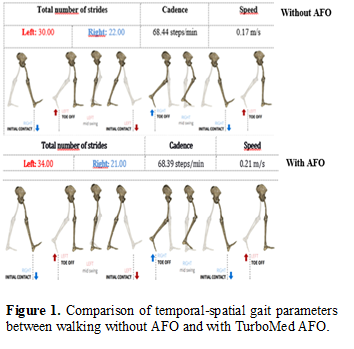
Stroke-related gait impairment is commonly associated with foot drop, reduced walking speed, poor balance, and asymmetrical lower-limb biomechanics. Ankle-foot orthoses (AFOs) are frequently prescribed to improve gait stability and walking efficiency in post-stroke rehabilitation. This study aimed to biomechanically evaluate the effectiveness of a ready-made TurboMed ankle-foot orthosis using three-dimensional gait analysis based on the Helen Hayes marker model. A post-stroke patient underwent motion capture gait assessment under two walking conditions: without an AFO and with a TurboMed AFO. Temporal-spatial and lower-limb kinematic parameters were analyzed and compared. The results demonstrated improvements in walking speed, heel clearance, ankle dorsiflexion, and gait stability during AFO-assisted walking. Walking speed increased from 0.17 m/s to 0.21 m/s, while double-support time decreased from 31.7% to 27.2%, indicating improved balance and confidence during gait. The TurboMed AFO also reduced excessive plantarflexion during swing phase and improved ankle alignment. These findings suggest that ready-made TurboMed AFOs can provide clinically meaningful biomechanical benefits for post-stroke gait rehabilitation.
Article Details
Section

This work is licensed under a Creative Commons Attribution-NonCommercial-ShareAlike 4.0 International License.
Licensed under a CC-BY license: https://creativecommons.org/licenses/by-nc-sa/4.0/
How to Cite


References
[1] Y. J. Choo and M. C. Chang, “Effectiveness of an ankle–foot orthosis on walking in patients with stroke: A systematic review and meta-analysis,” Scientific Reports, vol. 11, no. 1, 2021. https://doi.org/10.1038/s41598-021-95449-x
[2] S. Shahabi et al., “The effects of ankle-foot orthoses on walking speed in patients with stroke,” Clinical Rehabilitation, vol. 34, no. 2, pp. 145–159, 2020. https://doi.org/10.1177/0269215519887784
[3] G. Balaban and H. Tok, “Gait disturbances in patients with stroke,” PM&R, vol. 6, no. 7, pp. 635–642, 2014. https://doi.org/10.1016/j.pmrj.2013.12.017
[4] C. Lamontagne et al., “Mechanisms of disturbed motor control in ankle weakness after stroke,” Gait & Posture, vol. 15, no. 3, pp. 244–255, 2002. https://doi.org/10.1016/S0966-6362(01)00189-3
[5] S. F. Tyson et al., “Orthotic devices after stroke and other non-progressive brain lesions,” Cochrane Database of Systematic Reviews, 2013. https://doi.org/10.1002/14651858.CD003694.pub3
[6] A. Daryabor et al., “Effect of different designs of ankle-foot orthoses on gait in patients with stroke,” Gait & Posture, vol. 62, pp. 268–279, 2018. https://doi.org/10.1016/j.gaitpost.2018.03.026
[7] H. Chen et al., “Effects of ankle-foot orthoses on gait and balance in stroke rehabilitation,” Frontiers in Neurology, vol. 12, 2021. https://doi.org/10.3389/fneur.2021.654682
[8] A. Kobayashi et al., “Ankle-foot orthoses for stroke rehabilitation: A review of biomechanical effects,” Journal of Biomechanics, vol. 98, 2020. https://doi.org/10.1016/j.jbiomech.2019.109469
[9] R. Baker, Measuring Walking: A Handbook of Clinical Gait Analysis. Mac Keith Press, 2013.
[10] D. A. Winter, Biomechanics and Motor Control of Human Movement, 4th ed. Wiley, 2009.
[11] C. Kirtley, Clinical Gait Analysis: Theory and Practice. Elsevier, 2006.
[12] J. Perry and J. Burnfield, Gait Analysis: Normal and Pathological Function, 2nd ed. SLACK Incorporated, 2010.
[13] P. Bregman et al., “The effect of ankle-foot orthosis stiffness on the energy cost of walking,” Clinical Biomechanics, vol. 25, no. 2, pp. 177–183, 2010. https://doi.org/10.1016/j.clinbiomech.2009.10.007
[14] M. Everaert et al., “Effect of a foot-drop stimulator and ankle-foot orthosis on walking performance after stroke,” Neurorehabilitation and Neural Repair, vol. 27, no. 7, pp. 579–591, 2013. https://doi.org/10.1177/1545968313481278
[15] R. Patterson et al., “Evaluation of gait symmetry after stroke,” Gait & Posture, vol. 31, no. 2, pp. 241–246, 2010. https://doi.org/10.1016/j.gaitpost.2009.10.004
[16] J. Hausdorff, “Gait variability: Methods, modeling and meaning,” Journal of NeuroEngineering and Rehabilitation, vol. 2, no. 1, 2005. https://doi.org/10.1186/1743-0003-2-19
[17] Y. Yuan et al., “Gait asymmetry from unilateral weakness and improvement with ankle assistance,” 2026. https://arxiv.org/abs/2602.18862
[18] H. Wang et al., “Biomechanical analysis of ankle-foot orthoses in hemiplegic gait,” Applied Sciences, vol. 12, no. 4, 2022. https://doi.org/10.3390/app12042015