
Review on Hydraulic and Geotechnical Mechanisms of Riverbank Roadway Erosion and Collapse
Article Sidebar
Main Article Content
Abstract
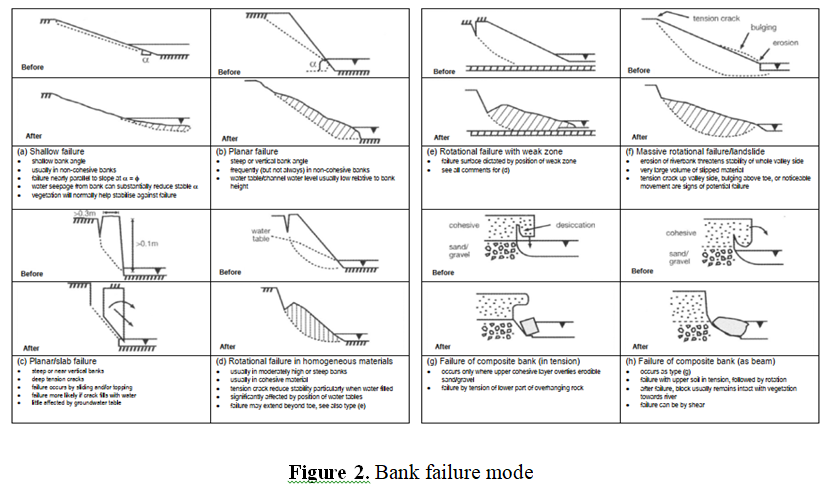
Riverbank erosion is a critical geomorphological process with significant impacts on river systems and adjacent infrastructure. In many regions, transportation networks are constructed near riverbeds, making them susceptible to bank instability and erosion. Hydraulic forces including flow velocity, turbulence, and shear stress play a major role in determining the rate of riverbank erosion. Concurrently, the geotechnical properties of bank materials, such as cohesion, permeability, and soil structure, influence the riverbank’s resistance to erosion and slope failure. The interplay between hydraulic dynamics and soil mechanical properties results in various bank failure mechanisms, including rotational slip, cantilever failure, and block failure. Additionally, traffic loads and human activities can exacerbate the instability of riverbanks adjacent to transportation infrastructure. This paper reviews previous researches on riverbank erosion, soil characteristics, hydraulic flow conditions, and the instability of roads near rivers. The review aims to identify the key factors controlling riverbank erosion and to highlight existing research gaps, particularly regarding the combined effects of hydraulic loading and traffic-induced stresses. A comprehensive understanding of these mechanisms is essential for developing effective strategies to stabilize riverbanks and safeguard transportation infrastructure.
Article Details
Section

This work is licensed under a Creative Commons Attribution-NonCommercial-ShareAlike 4.0 International License.
Licensed under a CC-BY license: https://creativecommons.org/licenses/by-nc-sa/4.0/
How to Cite


References
[1] L. Saikia, C. Mahanta, A. Mukherjee, and S. B. Borah, “Erosion–deposition and land use/land cover of the Brahmaputra river in Assam, India,” J. Earth Syst. Sci., vol. 128, no. 1, pp. 1–12, 2019.
[2] Z. Yao, W. Ta, X. Jia, and J. Xiao, "Bank erosion and accretion along the Ningxia–Inner Mongolia reaches of the Yellow River from 1958 to 2008," Geomorphology, vol. 127, no. 1-2, pp. 99-106, 2011
[3] G. Duan, A. Shu, M. Rubinato, S. Wang, and F. Zhu, “Collapsing mechanisms of the typical cohesive riverbank along the Ningxia–Inner Mongolia catchment,” Water, vol. 10, no. 9, p. 1272, 2018
[4] A. Shu, J. Gao, G. S. Duan, and X. Zhang, "Cluster analysis for factor classification and riverbank collapse along the desert wide valley reach of the upper Yellow River," J. Tsinghua Univ. (Sci. Tech.), vol. 8, pp. 1044-1048, 2014.
[5] W. Ta, H. Xiao, and Z. Dong, "Long-term morphodynamic changes of a desert reach of the Yellow River following upstream large reservoirs' operation," Geomorphology, vol. 97, no. 3-4, pp. 249-259, 2008.
[6] H. F. Andoh, B. O. Antwi, T. Wakatsuiki, and E. T. Atakora, "Estimation of soil erodibility and rainfall erosivity patterns in the agroecological zones of Ghana," Journal of Soil Science and Environmental Management, vol. 3, no. 11, pp. 275-279, 2012.
[7] A. M. Osman and C. R. Thorne, “Riverbank stability analysis. I: Theory,” Journal of Hydraulic Engineering, vol. 114, no. 2, pp. 134–150, 1988.
[8] S. Darby and C. Thorne, “Numerical simulation of widening and bed deformation of straight sand-bed rivers. I: Model development,” Journal of Hydraulic Engineering, vol. 122, no. 4, pp. 184–193, 1996.
[9] N. Casagli, M. Rinaldi, A. Cargini, and A. Curini, “Pore water pressure and stream bank stability: Results from a monitoring site on the Sieve River, Italy,” Earth Surface Processes and Landforms, vol. 24, pp. 1095–1114, 1999.
[10] A. Simon, A. Curini, S. E. Darby, and E. J. Langendoen, “Bank and near-bank processes in an incised channel,” Geomorphology, vol. 35, no. 3–4, pp. 193–217, 2000.
[11] K. Terzaghi and R. B. Peck, Soil Mechanics in Engineering Practice. New York, NY, USA: John Wiley & Sons, 1948.
[12] K. Sassa, H. Fukuoka, G. Wang, and N. Ishikawa, “Undrained dynamic-loading ring-shear apparatus and its application to landslide dynamics,” Landslides, vol. 1, no. 1, pp. 7–19, 2004.
[13] C. R. Thorne, R. D. Hey, and M. D. Newson, Applied Fluvial Geomorphology for River Engineering and Management. Chichester, UK: John Wiley & Sons, 1997.
[14] R. D. Hey, G. L. Heritage, N. K. Tovey, R. R. Boar, N. Grant, and R. K. Turner, “Streambank protection in England and Wales,” R&D Note 22, National Rivers Authority, 1991.
[15] S. Samadi, M. H. Davoudi, and E. Amiri-Tokaldany, “Experimental study of cantilever failure in the upper part of cohesive riverbanks,” Research Journal of Environmental Sciences, vol. 5, no. 5, pp. 444–452, 2011.
[16] M. H. Yu, H. Y. Wei, and S. B. Wu, “Experimental study on the bank erosion and interaction with near-bank bed evolution due to fluvial hydraulic force,” International Journal of Sediment Research, vol. 30, no. 1, pp. 81–89, 2015.
[17] [11] S. Patsinghasanee, I. Kimura, and Y. Shimizu, “Experimental and numerical study on overhanging failure of river bank,” 土木学会論文集 B1 (水工学), vol. 71, no. 4, pp. I_127–I_132, 2015.
[18] J. J. Musa, S. C. Anijofor, P. Obasa, and J. J. Avwevuruvwe, “Effects of soil physical properties on erodibility and infiltration parameters of selected areas in Gidan Kwano,” 2017.
[19] A. Simon, A. Curini, S. E. Darby, and E. J. Langendoen, “Bank and near-bank processes in an incised channel,” Geomorphology, vol. 35, no. 3–4, pp. 193–217, 2000.
[20] C. R. Thorne and N. K. Tovey, “Stability of composite river banks,” Earth Surface Processes and Landforms, vol. 6, no. 5, pp. 469–484, 1981.
[21] G. A. Yu, Z. Li, H. Yang, J. Lu, H. Q. Huang, and Y. Yi, “Effects of riparian plant roots on the unconsolidated bank stability of meandering channels in the Tarim River, China,” Geomorphology, vol. 351, p. 106958, 2020.
[22] C. R. Thorne, “Field measurements of rates of bank erosion and bank material strength,” in Erosion and Sediment Transport Measurement, 133, pp. 503–512, 1981.
[23] P. Y. Julien, Erosion and Sedimentation. Cambridge, UK: Cambridge University Press, 2010.
[24] W. C. Yu, “River boundary conditions of mechanism of bank failure in middle and lower reaches of Changjiang River,” Journal of Changjiang River Scientific Research Institute, vol. 25, no. 1, p. 8, 2008.
[25] P. Shrestha and N. K. Tamrakar, “Bank erosion process and bank material loss potential in Manahara River, Kathmandu, Nepal,” Bulletin of the Department of Geology, vol. 10, pp. 33–44, 2007.
[26] A. Gajanayake, G. Zhang, T. Khan, and H. Mohseni, “Postdisaster impact assessment of road infrastructure: State-of-the-art review,” Natural Hazards Review, vol. 21, no. 1, p. 03119002, 2020.
[27] R. Wang, H. Tang, and F. Zhou, “Stability analysis of roadbed under flood scouring,” Scientific Reports, vol. 14, no. 1, p. 4312, 2024.