
Nonlinear Finite Element Modeling and Experimental Evaluation of Reinforced Foamed Concrete T-Beams
Article Sidebar
Main Article Content
Abstract
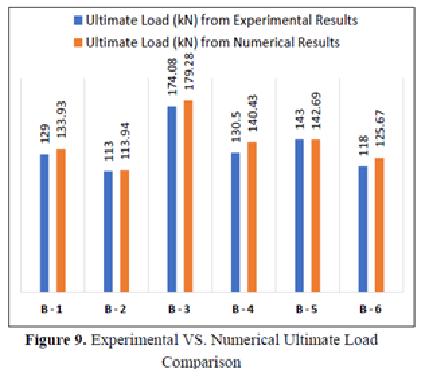
This study focuses on the structural behavior of reinforced foamed concrete T-beams, based on both experimental and theoretical/numerical comparisons by using ABAQUS. The Concrete Damage Plasticity (CDP) model in ABAQUS was employed to model the nonlinear behavior of foamed concrete T-beams, and the steel reinforcement was represented as an embedded truss element. The experimental results were used to validate the numerical results for ultimate load capacity, mid-span deflection, load-deflection response, and crack pattern. A good agreement between the experimental and numerical results was obtained. The average experimental ultimate load was 129.08 kN, and the average numerical ultimate load was 131.78 kN. A parametric study was conducted to simulate the response of foamed concrete T-beams subjected to a uniformly distributed load. Findings showed that distributed loading was successful at increasing load-carrying capacity and minimizing deflection, thereby improving structural performance. Thus, the developed numerical model can be considered well validated for predicting the behavior of fibered-foam reinforced concrete T-beams and for performing parametric studies.
Article Details
Section

This work is licensed under a Creative Commons Attribution-NonCommercial-ShareAlike 4.0 International License.
Licensed under a CC-BY license: https://creativecommons.org/licenses/by-nc-sa/4.0/
How to Cite


References
[1] S. M. Abed, R. A. Hadi, and H. J. Khaliefa, "Improving the mechanical properties of lightweight foamed concrete using various types of fibres," IOP Conference Series: Materials Science and Engineering, vol. 1067, no. 1, Art. no. 012029, 2021, doi: 10.1088/1757-899X/1067/1/012029.
[2] A. J. Njyman and A. A. Hilal, “Mechanical Properties of Hybrid Carbon Fibers Reinforced Modified Foamed Concrete,” Iraqi Journal of Civil Engineering (IJCE), vol. 19, no. 1, pp. 60–67, 2025, doi: 10.37650/ijce. 2025.190104.
[3] A. Compaore, J.-Y. N. K. Toure, D. E. P. Klenam, A. S. Merenga, T. K. Asumadu, J. D. Obayemi, N. Rahbar, C. Migwi, and W. O. Soboyejo, “Foam concrete with mineral additives: From microstructure to mechanical/physical properties, workability and durability,” Open Ceramics, vol. 23, Art. no. 100812, 2025, doi: 10.1016/j.oceram.2025.100812.
[4] J. F. Castillo-Lara, E. A. Flores-Johnson, A. Valadez-Gonzalez, P. J. Herrera-Franco, J. G. Carrillo, P. I. Gonzalez-Chi, and Q. M. Li, “Mechanical Properties of Natural Fiber Reinforced Foamed Concrete,” Materials, vol. 13, no. 14, Art. no. 3060, 2020, doi: 10.3390/ma13143060.
[5] T. Rossetto, D. A. Pohoryles, J. Melo, and H. Varum, “The effect of slab and transverse beams on the behaviour of full-scale pre-1970's RC beam-column joints,” in Proc. 16th World Conference on Earthquake Engineering (16WCEE), Santiago, Chile, Jan. 9–13, 2017, Paper No. 3826.
[6] A. M. Issa, M. M. Salem, M. T. Mostafa, H. M. Hadhoud, and H. H. Ghith, “Performance of shear reinforcement against punching shear loads,” International Journal of Engineering and Advanced Technology, vol. 9, no. 2, pp. 841–850, 2019, doi: 10.35940/ijeat.b3975.129219.
[7] M. Khalaf, A. El-Shihy, E.-S. El-Kasaby, and A. Youssef, “Numerical estimation and analysis of effective width of composite beams with ribbed slab,” International Journal of Application or Innovation in Engineering and Management, vol. 3, no. 8, pp. 1–15, 2014. doi: 10.2648/IJAIEM.120.237.
[8] N. Beningfield, R. Gaimster, and P. Griffin, “Investigation into the air void characteristics of foamed concrete,” in Use of Foamed Concrete in Construction, Thomas Telford Ltd., 2005, pp. 51–60, doi: 10.1680/uofcic.34068.0007.
[9] M. Kozlowski, M. Kadela, and M. Gwozdz-Lason, “Numerical fracture analysis of foamed concrete beam using XFEM method,” Applied Mechanics and Materials, vol. 837, pp. 183–186, 2016, doi: 10.4028/www.scientific.net/AMM.837.183
[10] O. A. Harry and N. E. Udoh, “Effect of flange width on flexural behavior of reinforced concrete T-beam,” Civil and Environmental Research, vol. 8, no. 8, 2016.
[11] P. D. and S. Krishnan, “Equation for the stress-strain curve of concrete,” ACI Journal Proceedings, vol. 61, no. 3, doi: 10.14359/7785.
[12] T. T. C. Hsu and Y. L. Mo, Unified Theory of Concrete Structures. 2010. doi: 10.1002/9780470688892.