
Optimized Task Offloading in Hybrid Cloud-Fog Computing for IoT Using Horse Herd Optimization Algorithm (HHOA)
Article Sidebar
Main Article Content
Abstract
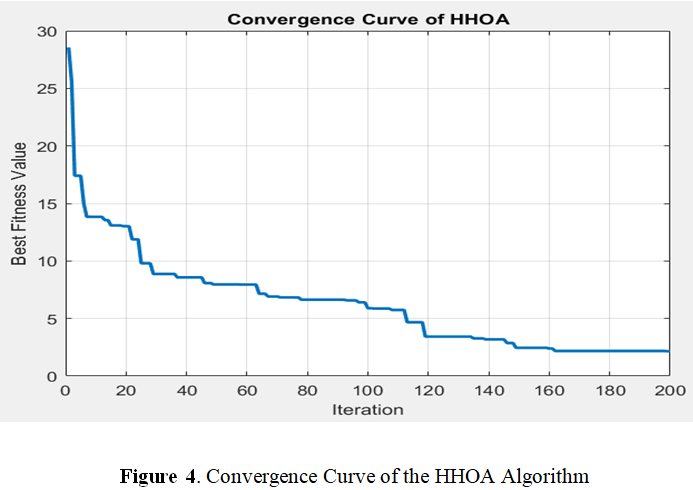
One of the main obstacles to enhancing the functionality is task offloading for Internet of Things (IoT) applications in hybrid cloud and fog computing environments. This study looks into an effective task offloading strategy that uses the Horse Herd Optimization Algorithm (HHOA) to reduce execution time and resource costs while ensuring balanced resource use. Unlike most previous studies that depend on synthetic datasets, this work uses a real-world IoT fog and cloud dataset sourced from Kaggle, which makes the evaluation more realistic and relevant. The dataset includes 120 tasks spread across 13 computing nodes, featuring 10 fog nodes and 3 cloud nodes, each with different processing capacities and resource costs. Simulation results show that HHOA achieves a total execution time of 0.9731 seconds, an optimal scheduling cost of 2.155, and a makespan of 6.1296 seconds. The highest recorded execution time per task was 0.8757 seconds. The highest execution cost per task was 0.8712. This shows minimal variation and balanced load distribution. The algorithm smartly assigned time-sensitive tasks to cloud nodes for quicker processing. It allocated less urgent tasks to fog nodes to preserve their limited CPU, RAM, and power resources. These findings confirm that HHOA effectively delivers a cost-efficient, performance-optimized, and resource-conscious method of job offloading for cloud computing and hybrid IoT fog settings.
Article Details
Section

This work is licensed under a Creative Commons Attribution-NonCommercial-ShareAlike 4.0 International License.
Licensed under a CC-BY license: https://creativecommons.org/licenses/by-nc-sa/4.0/
How to Cite


References
S. Yi, C. Li, and Q. Li, “A survey of fog computing: Concepts, applications and issues,” in Proc. 2015 Workshop on Mobile Big Data (Mobidata ’15), New York, NY, USA: ACM, 2015, pp. 37–42. [Online]. Available: http://doi.acm.org/10.1145/2757384.2757397
S. Kosta, A. Aucinas, P. Hui, R. Mortier, and X. Zhang, “Thinkair: Dynamic resource allocation and parallel execution in the cloud for mobile code offloading,” in 2012 Proc. IEEE INFOCOM, Mar. 2012, pp. 945–953.
R. Kemp, N. Palmer, T. Kielmann, and H. Bal, “Cuckoo: A computation offloading framework for smartphones,” in M. Gris and G. Yang, Eds., Mobile Computing, Applications, and Services, Berlin, Heidelberg: Springer, 2012, pp. 59–79.
E. Cuervo, A. Balasubramanian, D.-K. Cho, A. Wolman, S. Saroiu, R. Chandra, and P. Bahl, “Maui: Making smartphones last longer with code offload,” in Proc. 8th Int. Conf. Mobile Systems, Applications, and Services (MobiSys ’10), New York, NY, USA: ACM, 2010, pp. 49–62. [Online]. Available: http://doi.acm.org/10.1145/1814433.1814441
K. Hong, D. Lillethun, U. Ramachandran, B. Ottenwälder, and B. Koldehofe, “Mobile fog: A programming model for large-scale applications on the Internet of Things,” in Proc. 2nd ACM SIGCOMM Workshop on Mobile Cloud Computing (MCC ’13), New York, NY, USA: ACM, 2013, pp. 15–20. [Online]. Available: http://doi.acm.org/10.1145/2491266.2491270
P. Mell and T. Grance, “The NIST definition of cloud computing,” 2011.
N. Abbas, Y. Zhang, A. Taherkordi, and T. Skeie, “Mobile edge computing: A survey,” IEEE Internet of Things Journal, vol. 5, no. 1, pp. 450–465, 2017. DOI: 10.1109/JIOT.2017.2750180
F. Bonomi, R. Milito, J. Zhu, and S. Addepalli, “Fog computing and its role in the Internet of Things,” in First Edition of the MCC Workshop on Mobile Cloud Computing, 2012, pp. 13–16.
X. Hou, Y. Li, M. Chen, D. Wu, D. Jin, and S. Chen, “Vehicular fog computing: A viewpoint of vehicles as the infrastructures,” IEEE Trans. Veh. Technol., vol. 65, no. 6, pp. 3860–3873, 2016. DOI: 10.1109/TVT.2015.2478060
A. Yousefpour, C. Fung, T. Nguyen, K. Kadiyala, F. Jalali, A. Niakanlahiji, J. Kong, and J. P. Jue, “All one needs to know about fog computing and related edge computing paradigms: A complete survey,” J. Syst. Archit., vol. 98, pp. 289–330, 2019. [Online]. Available: http://www.sciencedirect.com/science/article/pii/S1383762118306349
T. G. Rodrigues, K. Suto, H. Nishiyama, N. Kato, and K. Temma, “Cloudlets activation scheme for scalable mobile edge computing with transmission power control and virtual machine migration,” IEEE Trans. Comput., vol. 67, no. 9, pp. 1287–1300, 2018. DOI: 10.1109/TC.2017.2776363
J. Zhao, Q. Li, Y. Gong, and K. Zhang, “Computation offloading and resource allocation for cloud-assisted mobile edge computing in vehicular networks,” IEEE Trans. Veh. Technol., vol. 68, no. 8, pp. 7944–7956, 2019. DOI: 10.1109/TVT.2019.2920459
T. T. Nguyen, L. B. Le, and Q. Le-Trung, “Computation offloading in MIMO-based mobile edge computing systems under perfect and imperfect CSI estimation,” IEEE Trans. Serv. Comput., vol. 14, no. 6, pp. 2011–2025, 2019. DOI: 10.1109/TSC.2018.2837891
Y. Dai, D. Xu, S. Maharjan, and Y. Zhang, “Joint computation offloading and user association in multi-task mobile edge computing,” IEEE Trans. Veh. Technol., vol. 67, no. 12, pp. 12313–12325, 2018. DOI: 10.1109/TVT.2018.2878138
I. Ullah, H.-K. Lim, Y.-J. Seok, and Y.-H. Han, “Optimal task offloading with deep Q-network for edge-cloud computing environment,” in 2022 13th Int. Conf. Inf. Commun. Technol. Convergence (ICTC), IEEE, 2022, pp. 406–411. DOI: 10.1109/ICTC55334.2022.9950965
A. Robles-Enciso and A. F. Skarmeta, “A multi-layer guided reinforcement learning-based tasks offloading in edge computing,” Computer Networks, vol. 220, p. 109476, 2023. DOI: 10.1016/j.comnet.2022.109476
T. H. Binh, H. Vo, B. M. Nguyen, and H. T. T. Binh, “Reinforcement learning for optimizing delay-sensitive task offloading in vehicular edge–cloud computing,” IEEE Internet of Things Journal, vol. 11, no. 2, pp. 2058–2069, 2023. DOI: 10.1109/JIOT.2023.3236115
A. Bhattacharya and P. De, “A survey of adaptation techniques in computation offloading,” J. Netw. Comput. Appl., vol. 78, pp. 97–115, Jan. 2017. [Online]. Available: https://doi.org/10.1016/j.jnca.2016.10.023
K. Kumar, J. Liu, Y.-H. Lu, and B. Bhargava, “A survey of computation offloading for mobile systems,” Mob. Netw. Appl., vol. 18, no. 1, pp. 129–140, Feb. 2013. [Online]. Available: http://dx.doi.org/10.1007/s11036-012-0368-0
A. Yousefpour, G. Ishigaki, and J. P. Jue, “Fog computing: Towards minimizing delay in the Internet of Things,” in 2017 IEEE Int. Conf. Edge Computing (EDGE), June 2017, pp. 17–24. DOI: 10.1109/EDGE.2017.13
L. Gu, D. Zeng, S. Guo, A. Barnawi, and Y. Xiang, “Cost efficient resource management in fog computing supported medical cyber-physical system,” IEEE Trans. Emerg. Topics Comput., vol. 5, no. 1, pp. 108–119, Jan. 2017. DOI: 10.1109/TETC.2015.2494342
R. Deng, R. Lu, C. Lai, T. H. Luan, and H. Liang, “Optimal workload allocation in fog-cloud computing toward balanced delay and power consumption,” IEEE Internet of Things Journal, vol. 3, no. 6, pp. 1171–1181, Dec. 2016. DOI: 10.1109/JIOT.2016.2597162
D. Zeng, L. Gu, S. Guo, Z. Cheng, and S. Yu, “Joint optimization of task scheduling and image placement in fog computing supported software-defined embedded system,” IEEE Trans. Comput., vol. 65, no. 12, pp. 3702–3712, Dec. 2016. DOI: 10.1109/TC.2016.2604341
Y. Chen, Y. Chang, C. Chen, Y. Lin, J. Chen, and Y. Chang, “Cloudfog computing for information-centric Internet-of-Things applications,” in 2017 Int. Conf. Appl. System Innovation (ICASI), May 2017, pp. 637–640. DOI: 10.1109/ICASI.2017.7988328
Y.-L. Jiang, Y.-S. Chen, S.-W. Yang, and C.-H. Wu, “Energy-efficient task offloading for time-sensitive applications in fog computing,” IEEE Syst. J., vol. 99, pp. 1–12, Nov. 2018. DOI: 10.1109/JSYST.2018.2881638
M. Huang, W. Liu, T. Wang, A. Liu, and S. Zhang, “A cloud-MEC collaborative task offloading scheme with service orchestration,” IEEE Internet of Things Journal, 2019. DOI: 10.1109/JIOT.2019.2920452
Y. Liu, Z. Zeng, X. Liu, X. Zhu, and M. Z. A. Bhuiyan, “A novel load balancing and low response delay framework for edge-cloud network based on SDN,” IEEE Internet of Things Journal, 2019. DOI: 10.1109/JIOT.2019.2902824
S. Zahoor, N. Javaid, A. Khan, B. Ruqia, F. J. Muhammad, and M. Zahid, “A cloud-fog-based smart grid model for efficient resource utilization,” in 2018 14th Int. Wireless Commun. Mobile Comput. Conf. (IWCMC), June 2018, pp. 1154–1160. DOI: 10.1109/IWCMC.2018.8450487
S. Zahoor, S. Javaid, N. Javaid, M. Ashraf, F. Ishmanov, and M. K. Afzal, “Cloud–fog–based smart grid model for efficient resource management,” Sustainability, vol. 10, no. 6, 2018. [Online]. Available: https://www.mdpi.com/2071-1050/10/6/2079
S. A. A. Naqvi, N. Javaid, H. Butt, M. B. Kamal, A. Hamza, and M. Kashif, “Metaheuristic optimization technique for load balancing in cloud-fog environment integrated with smart grid,” in L. Barolli, N. Kryvinska, T. Enokido, and M. Takizawa, Eds., Advances in Network-Based Information Systems, Cham: Springer, 2019, pp. 700–711. DOI: 10.1007/978-3-030-15809-8_59
S. Ningning, G. Chao, A. Xingshuo, and Z. Qiang, “Fog computing dynamic load balancing mechanism based on graph repartitioning,” China Commun., vol. 13, no. 3, pp. 156–164, Mar. 2016. DOI: 10.1109/CC.2016.7447795
S. Bitam, S. Zeadally, and A. Mellouk, “Fog computing job scheduling optimization based on bees swarm,” Enterprise Inf. Syst., vol. 12, no. 4, pp. 373–397, 2018. DOI: 10.1080/17517575.2017.1304579
H. T. T. Binh, T. T. Anh, D. B. Son, P. A. Duc, and B. M. Nguyen, “An evolutionary algorithm for solving task scheduling problem in cloud-fog computing environment,” in Proc. 9th Int. Symp. Inf. Commun. Technol. (SoICT 2018), New York, NY, USA: ACM, 2018, pp. 397–404. [Online]. Available: http://doi.acm.org/10.1145/3287921.3287984
B. M. Nguyen, H. T. T. Binh, T. The Anh, and D. B. Son, “Evolutionary algorithms to optimize task scheduling problem for the IoT based bag-of-tasks application in cloud–fog computing environment,” Appl. Sci., vol. 9, no. 9, p. 1730, 2019. [Online]. Available: https://www.mdpi.com/2076-3417/9/9/1730
A. Mebrek, L. Merghem-Boulahia, and M. Esseghir, “Efficient green solution for a balanced energy consumption and delay in the IoT-fog-cloud computing,” in 2017 IEEE 16th Int. Symp. Netw. Comput. Appl. (NCA), Oct. 2017, pp. 1–4. DOI: 10.1109/NCA.2017.8080318
Y. Li and S. Wang, “An energy-aware edge server placement algorithm in mobile edge computing,” in 2018 IEEE Int. Conf. Edge Computing (EDGE), Los Alamitos, CA, USA: IEEE, Jul. 2018, pp. 66–73. [Online]. Available: http://doi.ieeecomputersociety.org/10.1109/EDGE.2018.00016
Q. Wang and S. Chen, “Latency-minimum offloading decision and resource allocation for fog-enabled Internet of Things networks,” Trans. Emerg. Telecommun. Technol., p. e3880, 2020. [Online]. Available: https://onlinelibrary.wiley.com/doi/abs/10.1002/ett.3880
C. Canali and R. Lancellotti, “GASP: Genetic algorithms for service placement in fog computing systems,” Algorithms, vol. 12, no. 10, p. 201, 2019. [Online]. Available: https://www.mdpi.com/1999-4893/12/10/201