
Construction Waste Reduction in Yola using Circular Economy Approach
Article Sidebar
Main Article Content
Abstract
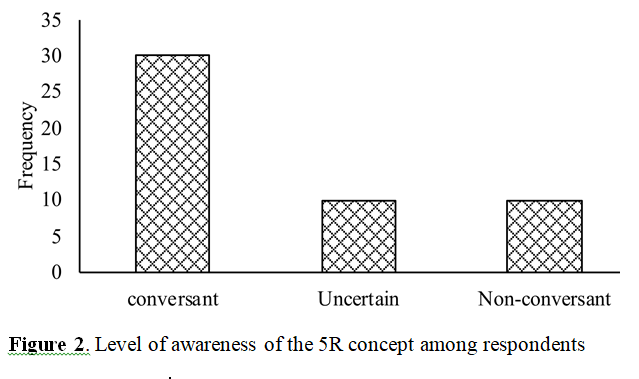
The rapid growth in construction activities in Nigeria generates substantial waste, posing significant environmental challenges. The 5R framework (Refuse, Reduce, Reuse, Repurpose, and Recycle) is a pivotal circular economy strategy for mitigating this issue. This study assesses the composition of construction waste, identifies causative factors, and evaluates the adoption of the 5R concept by construction firms in Yola, Nigeria. A quantitative approach was employed utilizing a structured questionnaire survey administered to 50 construction professionals. Data analysis using descriptive statistics and the Relative Importance Index (RII) revealed a significant gap between awareness and practice; while 60% of respondents were aware of the 5R principle, only 39% implemented it. Tile and wood were identified as the most prevalent waste materials. The primary causes of waste were design modifications, inability to reuse materials, and errors in material specifications. The findings indicate that chronic issues like design changes and inadequate planning persist despite known solutions, indicating that the barriers are rooted in economic, cultural, and regulatory domains rather than a lack of knowledge. The study concludes that overcoming the implementation gap requires a multi-faceted approach, including targeted policy interventions such as enforced waste management plans and landfill taxes, economic incentives demonstrating cost savings, and practical on-site training for workers. Translating 5R awareness into effective jobsite practice is essential for sustainable construction waste management in Yola and other areas with similar waste management challenges.
Article Details
Section

This work is licensed under a Creative Commons Attribution-NonCommercial-ShareAlike 4.0 International License.
Licensed under a CC-BY license: https://creativecommons.org/licenses/by-nc-sa/4.0/
How to Cite


References
M. H. Hassan, A. Y. Mohamed, A. M. Ibrahim, Z. A. Roble, and A. T. Balasbaneh, “A Review of Strategies to Prevent On-Site Construction Waste,” J. Advan. Environ. Sol. Res. Rec., vol. 2, no. 2, pp. 19–26, 2022.
C. Luangcharoenrat, S. Intrachooto, V. Peansupap, and W. Sutthinarakorn, “Factors influencing construction waste generation in building construction: Thailand’s perspective,” Sustain., vol. 11, no. 13, p. 3638, 2019.
Z. A. Belel, W. A. Belel, M. H. Abubakar, Z. B. Ahmed, Z. Daud, and H. Awang, “Socio-economic development of transportation in Fufore, Nigeria,” Int. J. Integr. Eng., vol. 10, no. 8, pp. 1-8, 2018.
Z. B. Ahmad, H. A. Mahmoud, and S. K. Balla, “EFFECTS OF ROAD PROJECT PARAMETERS ON FEDERAL CAPITAL TERRITORY ADMINISTRATION COST OVERRUNS,” Nig. J. Eng. Sci. Technol. Res., vol. 9, no. 1, pp. 58–64, 2023.
R. Fidelis, E. D. R. Guerreiro, D. J. Horst, G. M. Ramos, B. R. de Oliveira, and P. P. de Andrade Junior, “Municipal solid waste management with recyclable potential in developing countries: Current scenario and future perspectives,” Waste Manag. Res., 2023. doi:10.1177/0734242X231160084
R. U. Duru, E. E. Ikpeama, and J. A. Ibekwe, “Challenges and prospects of plastic waste management in Nigeria,” Waste Dispos Sustain Energy, vol. 1, pp. 117–126, 2019.
E. C. Eze, R. Seghosime, O. P. Eyong, and O. S. Loya, “Assessment of materials waste in the construction industry: A view of Construction Operatives, Tradesmen and Artisans in Nigeria,” Int J Eng Sci (Ghaziabad), vol. 6, no. 4, pp. 32–47, 2017.
D. Kannan, S. Khademolqorani, N. Janatyan, and S. Alavi, “Smart waste management 4.0: The transition from a systematic review to an integrated framework,” Waste Manag., vol. 174, pp. 1–14, 2024.
H. A. Mahmoud, “TRENDS IN THE REMEDIATION METHODS FOR LANDFILL LEACHATE,” Nig. J. Eng. Sci. Technol. Res., vol. 9, no. 2, pp. 149–160, 2023.
O. O. Faniran and G. Caban, “Minimizing waste on construction project sites,” Eng. Constr. Archit. Manag., vol. 5, no. 2, pp. 182–188, 1998.
M. A. Akhund, N. A. Memon, T. H. Ali, A. H. Memon, and H. U. Imad, “Construction waste management techniques: merits and challenges for recycling and reusing,” in Proc. Int. Conf. Ind. Eng. Oper. Manag., Riyadh, Saudi Arabia, 2019, pp. 1015–1022.
M. A. Akhund, A. H. Memon, T. H. Ali, N. A. Memon, and S. Kazi, “Waste management in construction projects of pakistan,” Pak J Sci, vol. 71, no. 4, p. 59, 2019.
A. O. Afolabi, P. F. Tunji-Olayeni, R. A. Ojelabi, and O. I. Omuh, “Construction waste prevention as a sustainable tool in building mega cities: a theoretical framework,” in IOP Conf. Ser.: Earth and Environ. Sci, vol. 146, 2018, Art. no. 012013.
L. Muhwezi, L. M. Chamuriho, and N. M. Lema, “An investigation into materials wastes on building construction projects in Kampala-Uganda,” Schol. J. Eng. Res., vol. 1, no. 1, pp. 11–18, 2012.
W. Ma, M. de Jong, F. Zisopoulos, and T. Hoppe, “Introducing a classification framework to urban waste policy: Analysis of sixteen zero-waste cities in China,” Waste Manag., vol. 165, pp. 94–107, 2023.
K. K. Meshram, “The circular economy, 5R framework, and green organic practices: pillars of sustainable development and zero-waste living. Discov Environ vol. 2, 2024, Art. no. 147. https://doi.org/10.1007/s44274-024-00177-4
W. K. Balwan, A. Singh, and S. Kour, “5R’s of zero waste management to save our green planet: A narrative review,” Eur. J. Biotechnol. Biosci., vol. 10, no. 1, pp. 7–11, 2022.
U. Aftab, M. Aslam, A. Ulhaq, F. Jaleel, S. Malik, and H. Zahoor, “Deconstructing construction wastes: Exploring waste generation causes and their impact on project performances,” Plos One, vol. 20, no. 5, 2025, Art. no. e0322295.
S. D. Olanrewaju, and O. E. Ogunmakinde, “Waste minimisation strategies at the design phase: Architects’ response.” Waste Manag., vol. 118, pp. 323-330, 2020. doi: 10.1016/j.wasman.2020.08.045
H. C. O. Unegbu, D. S. Yawas, B. Dan-Asabe, and A. A. Alabi, “Optimising waste management strategies for sustainable construction: Assessing the implementation of circular economy principles in Nigeria,” J. Ilmiah Teknol. Rekayasa, vol. 29, no. 3, pp. 276-301, 2024.
L. Godfrey, M. T. Ahmed, K. Giday, et al., "Solid Waste Management in Africa: Governance Failure or Development Opportunity?," in Reg. Dev. Afr. IntechOpen, 2019. doi: 10.5772/intechopen.86974.
O. O. Oyebanjo, O. Bidemi, O. A. Posun, & O. Sofolahan, (2023). Materials wastage on construction sites in Lagos Nigeria. TASUED J. Pure Appl. Sci., 2(1), 190-200.
National Population Commission (Nigeria), Population of Yola North Local Government Area. City Population, 2022. [Online]. Available: https://www.citypopulation.de/en/nigeria/admin/adamawa/NGA002020__yola_north/. [Accessed: Aug. 12, 2025].
O. O. Fadiya, P. Georgakis, and E. Chinyio, "Quantitative analysis of the sources of construction waste," J. Constr. Eng., vol. 2014, 2014, Art. no. 651060.
J. D. Smith and M. Hasan, "Quantitative approaches for the evaluation of implementation research studies," Psych. Res., vol. 283, p. 112521, Jan. 2020.
R. A. Begum, C. Siwar, J. J. Pereira, and A. H. Jaafar, "A benefit-cost analysis on the economic feasibility of construction waste minimisation: The case of Malaysia," Resour. Conserv. Recycl., vol. 48, no. 1, pp. 86-98, 2006.
H. Taherdoost, "Sampling methods in research methodology; how to choose a sampling technique for research," Int. J. Acad. Res. Manag., vol. 5, no. 2, pp. 18-27, 2016.
D. O. Adegbo, E. Achuenu, and I. M. Eyemogun, “Construction material waste management practices in selected construction sites in Abuja, Nigeria,” J. Manag. Technol., vol. 1, no. 2, pp. 69 – 104.
A. Joshi, S. Kale, S. Chandel, and D. Pal, "Likert Scale: Explored and Explained," Br. J. Appl. Sci. Technol., vol. 7, no. 4, pp. 396-403, 2015.