
Optimization of Production Throughput and Quality Control Metrics: A Case Study in Home Appliance Assembly
Article Sidebar
Main Article Content
Abstract
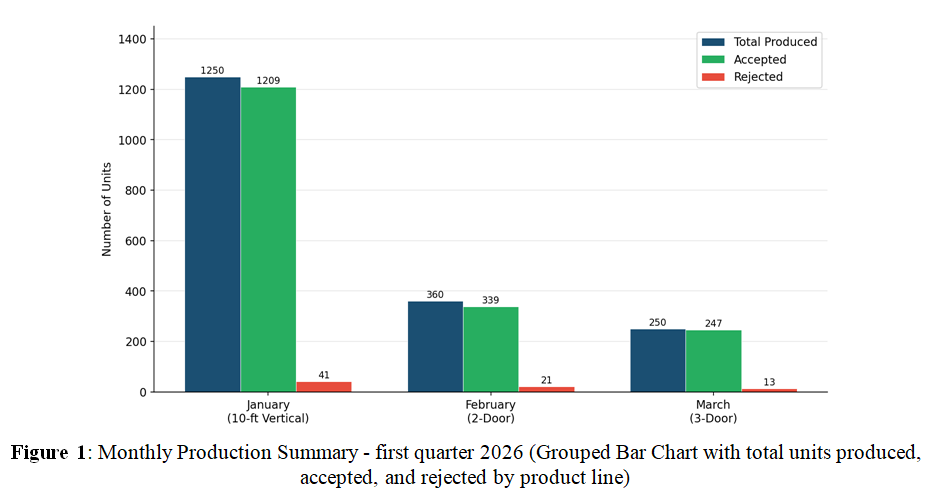
The given research paper is a rather detailed quantitative study of the daily and monthly production rates and defects in the production of home appliances in the General Company of Light Industry, Iraq, in the first quarter of 2026. Three different product lines have been studied in terms of the 10-foot vertical display unit (January), 2-door display unit (February), and 3-door display unit (March). The methods of statistical process control (SPC) such as p-control chart and Pareto analysis were used to describe the defects occurrences, out-of-control conditions and the root causes. Total production volumes were 1,250, 360, and 250 units, with overall efficiencies of 96.72%, 94.17%, and 90.80% respectively. The overall rate of rejection in all three months was 4.07% (75 rejected out of 1,860 total units). The most common types of defects were injection mold (March), shortages in the quantity of the foam (all months), and external structural damage (January and March). Ishikawa analysis was applied to trace the causes systematically to materials, machine conditions, human factors, and environmental disturbances such as lack of power. Recommendations that combine Six Sigma DMAIC approach, preventive maintenance regimes and corrective process controls to operational excellence are provided.
Article Details
Section

This work is licensed under a Creative Commons Attribution-NonCommercial-ShareAlike 4.0 International License.
Licensed under a CC-BY license: https://creativecommons.org/licenses/by-nc-sa/4.0/
How to Cite


References
[1] Montgomery, D. C. (2020). Introduction to Statistical Quality Control (8th ed.). John Wiley & Sons. https://doi.org/10.1002/9781119657880
[2] Juran, J. M., & Godfrey, A. B. (1999). Juran's Quality Handbook (5th ed.). McGraw-Hill.
[3] Montgomery, D. C. (2013). Statistical Quality Control: A Modern Introduction (7th ed.). John Wiley & Sons.
[4] Juran, J. M. (1988). Juran on Planning for Quality. Free Press.
[5] Al-Rawi, K. H., & Hassan, M. A. (2022). Impact of Infrastructure Deficiencies on Manufacturing Process Stability in Iraqi Industrial Facilities. Journal of Engineering and Applied Sciences, 17(4), 112–125.
[6] Omran, S. H., Hussain, H. A., Abdullah, M., Habeeb, L. J., & Sa'i, M. A. R. (2026). Statistical Analysis of Production Efficiency and Defect Characterization in Home Appliance Manufacturing: A 2024 Case Study of Vertical Display Units. ISAR Journal of Science and Technology. https://article.isarpublisher.com/viewArticle/Statistical-Analysis-of-Production-Efficiency-and-Defect-Characterization-in-Home-Appliance-Manufacturing-A-2024-Case-Study-of-Vertical-Display-Units
[7] Shewhart, W. A. (1931). Economic Control of Quality of Manufactured Product. D. Van Nostrand Company.
[8] Ryan, T. P. (2011). Statistical Methods for Quality Improvement (3rd ed.). John Wiley & Sons.
[9] Woodall, W. H. (2000). Controversies and Contradictions in Statistical Process Control. Journal of Quality Technology, 32(4), 341–350.
[10] Krajewski, L. J., Ritzman, L. P., & Malhotra, M. K. (2019). Operations Management: Processes and Supply Chains (12th ed.). Pearson.
[11] Taguchi, G., Chowdhury, S., & Wu, Y. (2005). Taguchi's Quality Engineering Handbook. John Wiley & Sons.
[12] Tao, F., Qi, Q., Liu, A., & Kusiak, A. (2018). Data-Driven Smart Manufacturing. Journal of Manufacturing Systems, 48, 157–169.
[13] Antony, J., Snee, R., & Hoerl, R. (2017). Lean Six Sigma: Yesterday, Today and Tomorrow. International Journal of Quality & Reliability Management, 34(7), 1073–1093.
[14] Pyzdek, T., & Keller, P. A. (2018). The Six Sigma Handbook (5th ed.). McGraw-Hill Education.
[15] Ishikawa, K. (1990). Introduction to Quality Control. 3A Corporation.
[16] Singh, R., & Khanduja, D. (2017). Process Optimization in Polyurethane Foam Injection for Refrigeration Appliances. International Journal of Advanced Manufacturing Technology, 91(9–12), 3401–3414.
[17] Abdulhafedh, A. (2021). Road Crash Prediction Models: Different Statistical Modeling Approaches. Journal of Transportation Technologies, 11(3), 398–411.
[18] Reason, J. (2000). Human Error: Models and Management. British Medical Journal, 320(7237), 768–770.
[19] Shingo, S. (1986). Zero Quality Control: Source Inspection and the Poka-Yoke System. Productivity Press.
[20] Nelson, L. S. (1984). The Shewhart Control Chart — Tests for Special Causes. Journal of Quality Technology, 16(4), 237–239.
[21] Menges, G., Michaeli, W., & Mohren, P. (2001). How to Make Injection Molds (3rd ed.). Hanser Gardner Publications.
[22] Evans, J. R., & Lindsay, W. M. (2020). Managing for Quality and Performance Excellence (10th ed.). Cengage Learning.
[23] Boothroyd, G., Dewhurst, P., & Knight, W. A. (2011). Product Design for Manufacture and Assembly (3rd ed.). CRC Press.
[24] Yelle, L. E. (1979). The Learning Curve: Historical Review and Comprehensive Survey. Decision Sciences, 10(2), 302–328.
[25] Breyfogle, F. W. (2003). Implementing Six Sigma: Smarter Solutions Using Statistical Methods (2nd ed.). John Wiley & Sons.
[26] Mobley, R. K. (2002). An Introduction to Predictive Maintenance (2nd ed.). Butterworth-Heinemann.
[27] Liker, J. K. (2004). The Toyota Way: 14 Management Principles from the World's Greatest Manufacturer. McGraw-Hill.