
Spatial Analysis and Performance Evaluation of Hospital Wastewater Treatment Plants Using GIS-Based Kernel Density Estimation and Buffer Analysis: Basrah Governorate
Article Sidebar
Main Article Content
Abstract
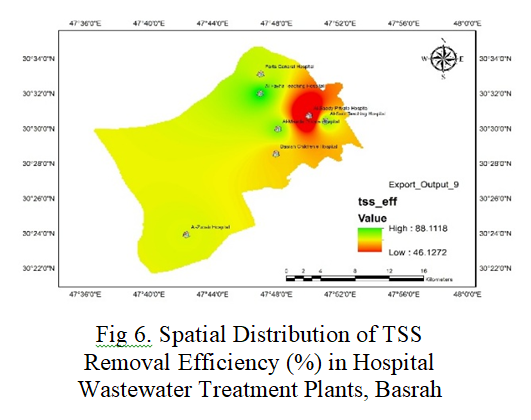
Higher Hospital wastewater (HWW) poses a significant and under-regulated environmental threat in developing regions. This study aimed to evaluate the performance of hospital wastewater treatment plant (HWWTs) in Basrah governorate, Iraq, using a spatially explicit approach to address the critical gap in site-specific environmental assessment. A geospatial database was developed for seven HWWTs, and their pollutant removal efficiencies were quantified. Performance variability was analyzed using Kernel density estimation (KDE) to identify pollution hotspots and multi-distance buffer analysis(500-1500m) was employed to assess environmental risk zones. Results indicated inconsistent treatment performance, with acceptable removal for organic load (BOD/COD) but critically low efficiency for nutrients particularly phosphate (PO43-), which ranged from 20.4% to 64.1%. the spatial analysis revealed district clusters of low-performing facilities, identifying specific hospitals as significant hotspots for effluent discharge. The buffer analysis confirmed a cumulative environmental risk, with potential impacts extending to the Shatt Al-Arab River, the region’s primary water source. The study concludes that the current treatment infrastructure is inadequate for the complex HWW matrix, especially concerning nutrient management. The finding validates GIS-Based spatial analysis as powerful evidence-based tool for environmental authorities to prioritize regulatory enforcement and implement site-specific management strategies in Basrah governorate.
Article Details
Section

This work is licensed under a Creative Commons Attribution-NonCommercial-ShareAlike 4.0 International License.
Licensed under a CC-BY license: https://creativecommons.org/licenses/by-nc-sa/4.0/
How to Cite


References
[1] Majumder A., Gupta A. K. , Ghosal P. S., Varma M. (2020). A review on hospital wastewater treatment: A special emphasis on occurrence and removal of pharmaceutically active compounds, resistant microorganisms, and SARS-CoV-2. Journal of Environ. Chem. Eng. 2020 Nov 22;9(2):104812. https://doi.org/10.1016/j.jece.2020.104812
[2] Zhang X., Yan S., Chen J., Tyagi R. D., & Li J. (2020). Physical, chemical, and biological impact (hazard) of hospital wastewater on environment: presence of pharmaceuticals, pathogens, and antibiotic-resistance genes. In Current Developments in Biotechnology and Bioengineering (pp. 79-102). Elsevier. https://doi.org/10.1016/B978-0-12-819722-6.00003-1
[3] Top S., Akgün M., Kıpçak E., Bilgili M. S. (2020). Treatment of hospital wastewater by supercritical water oxidation process. Water Research 185(15), 116279. https://doi.org/10.1016/j.watres.2020.116279
[4] Moyel M. S., Akbar M. M., Hussain N. A. (2023). Evaluation of spatio temporal changes in water quality in the middle section of the Shatt al Arab River, Southern Iraq. Journal of Ecological Engineering. 24(4), 297–311 https://doi.org/10.12911/22998993/161014
[5] Allafta, H., Opp, C. (2020). Spatio-temporal variability and pollution sources identification of the surface sediments of Shatt Al-Arab River, Southern Iraq. Sci Rep 10, 6979. https://doi.org/10.1038/s41598-020-63893-w
[6] Al-Miyahi, E. K. A. (2016). The impact of liquid medical pollutants generated from governmental hospitals on aquatic environmental pollution in Basrah City (Unpublished master’s thesis). University of Basrah.
[7] Al-Enazi, M. S. (2016). Evaluation of wastewater discharge from Al-Sadr Teaching Hospital and its impact on the Al-Khorah Channel and Shatt Al-Arab River in Basra City, Iraq. Journal of Environment and Earth Science, 6(12), 55–65.
[8] Al-Khafaji, S. A., Al-Rekabi, W. S., & Abbas, S. A. (2023). Evaluation of the efficiency of the Al-Mauany Hospital sewage treatment plant in Basrah City. IOP Conference Series: Earth and Environmental Science, 1215, 012051.
[9] Alsingery, B. R., Alabbawy, D. A., & Almahmoo, H. K. (2023). Assessment of sanitation system flowing water characteristics in selected hospitals in Basra City, Iraq. IOP Conference Series: Earth and Environmental Science, 1215, 012051.
[10] Al-Sultan, A. A., Kadhem, R. J., & Alabdraba, W. M. Sh. (2017). Evaluation of the quality of disposed wastewater in selected hospitals in Baghdad City. Journal of Environmental Studies, 17, 35–41.
[11] Al-Ajlouni, K., Shakhatreh, S., Al-Ibraheem, N., & Jawarneh, M. (2013). Evaluation of wastewater discharge from hospitals in Amman, Jordan. International Journal of Basic & Applied Sciences, 13(4), 44–52.
[12] Bimeyimana, A., Maniragaba, A., Mupenzi, C., & Bazambanza, A. (2020). Physico-chemical and bacteriological analysis of wastewater from hospital: Case of Centre University Teaching Hospital of Kigali. International Journal of Environmental & Agriculture Research, 6(3), 20–32.
[13] World Health Organization. (2014). Safe management of wastes from health-care activities (2nd ed.). WHO Press.
[14] Verlicchi, P., & Grillini, V. (2017). Hospital wastewater treatments adopted in Asia, Africa, and Australia. In The Handbook of Environmental Chemistry (Vol. 60, pp. 171–188). Springer.
[15] Paucar, N. E., Verlicchi, P., & Zanni, G. (2020). A review on hospital wastewater treatment: Recent achievements and future perspectives. Journal of Environmental Management, 277, 111399.
[16] Farah Mahdi, Ban Abdul Razzaq1, Maytham Sultan (2023). Assessment of Shatt Al-Arab water quality using water quality index and GIS techniques. Iraqi Journal of Science, 2023, Vol. 64, No. 1, pp: 480-491. https://doi.org/ 10.24996/ijs.2023.64.1.42
[17] Yu-Pin Lin, Hone-Jay Chu, Chen-Fa Wu, Tsun-Kuo Chang and Chiu-Yang Chen (2011). Hotspot Analysis of Spatial Environmental Pollutants Using Kernel Density Estimation and Geostatistical Techniques. Int. J. Environ. Res. Public Health 2011, 8, 75-88. https://doi.org/ 10.3390/ijerph8010075
[18] ESRI. (n.d.). Spatial analysis in ArcGIS Pro. ArcGIS Pro Documentation. Retrieved December 1, 2025, from https://pro.arcgis.com/en/pro-app/latest/help/analysis/introduction/spatial-analysis-in-arcgis-pro.htm
[19] Al-Asadi, S.A.R. and Alhello, A.A. (2019) ‘General assessment of Shatt Al-Arab River, Iraq’. Int. J. Water, Vol. 13, No. 4, pp.360–375.
[20] APHA (2017). Standard Methods for the Examination of Water and Wastewater (23rd ed.). American Public Health Association. https://www.standardmethods.org
[21] Metcalf & Eddy (2014). Wastewater Engineering: Treatment and Resource Recovery (5th ed.). McGraw-Hill Education.
[22] ESRI (2023). Buffer Analysis—ArcGIS Pro Documentation.https://pro.arcgis.com/en/pro-app/latest/tool-reference/analysis/buffer.htm
[23] Ali, S. H., Najemaden, M. A., & Ahmed, R. T. (2018). Using GIS techniques for mapping the pollution of particulate materials in Kirkuk. Sustainable Resources Management Journal, 3(2), 58–66. https://doi.org/10.5281/zenodo.1287926
[24] Li, J., & Heap, A. D. (2014). Spatial interpolation methods applied in the environmental sciences: A review. Environmental Modelling & Software, 53, 173–189.
[25] ESRI (2023). Kernel Density—Spatial Analyst Tools.https://pro.arcgis.com/en/pro-app/latest/tool-reference/spatial-analyst/kernel-density.htm
[26] Silverman, B. W. (1986). Density Estimation for Statistics and Data Analysis. Chapman & Hall. https://www.crcpress.com/Density-Estimation-for-Statistics-and-Data-Analysis/Silverman/p/book/9780412246203
[27] World Health Organization. (2006). WHO Guidelines for the Safe Use of Wastewater, Excreta and Greywater (Vol. 2). WHO Press. https://www.who.int/publications/i/item/9241546832