
Shrinkage Mitigation Strategies for Concrete Bridge Decks: A Systematic Review and Bibliometric Analysis
Article Sidebar
Main Article Content
Abstract
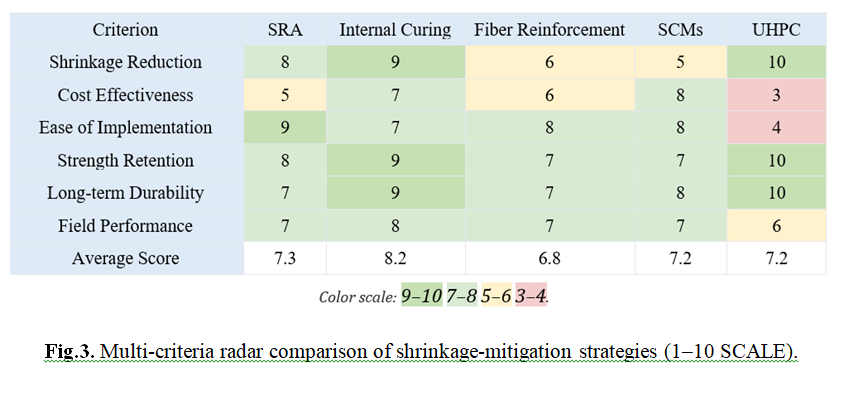
Concrete bridge decks develop early-age shrinkage cracks which create a widespread durability issue that speeds up steel reinforcement corrosion and requires more maintenance expenses and shortens the lifespan of the bridge. The study will conduct an organized evaluation to identify classification methods and assess the success rates of shrinkage control techniques used for concrete bridge decks. The research will identify missing information to direct upcoming studies and operational procedures in the field. Systematic review (PRISMA), which analyzed 154 studies published between 2000 and 2025 that they found in Scopus and Web of Science and various engineering databases. Bibliometric analysis performed to map research trends, geographic distribution, and thematic clusters. The study discovered nine main strategies which were analyzed against each other including shrinkage-reducing admixtures, fiber reinforcement, internal curing with lightweight aggregates, supplementary cementitious materials, expansive agents, optimized mix design, improved curing practices, and combined multi-strategy approaches. Shrinkage-reducing admixtures reduced drying shrinkage by (25-40) %, internal curing by (30-45) %, and UHPC overlays by up to 55%. The combination of shrinkage-reducing admixtures and internal curing methods led to a 52% decrease in results. Fiber reinforcement primarily controlled crack widths rather than total shrinkage strain. The combination of multiple strategic approaches produces better results than using each method independently. The highest performing UHPC solution becomes unaffordable because it requires a major increase in project expenses.
Article Details
Section

This work is licensed under a Creative Commons Attribution-NonCommercial-ShareAlike 4.0 International License.
Licensed under a CC-BY license: https://creativecommons.org/licenses/by-nc-sa/4.0/
How to Cite


References
[1] P. D. Krauss and E. A. Rogalla, "Transverse cracking in newly constructed bridge decks," NCHRP Report 380, Transportation Research Board, Washington, DC, 1996.
[2] D. Darwin, J. Browning, and W. D. Lindquist, "Control of cracking in bridge decks: Observations from the field," Cement, Concrete and Aggregates, vol. 26, no. 2, pp. 148–154, 2004.
[3] ACI Committee 231, "Report on early-age cracking: Causes, measurement, and mitigation," ACI 231R-10, American Concrete Institute, Farmington Hills, MI, 2010.
[4] J. Weiss, "Experimental determination of the time zero: A comparison of methods," Materials and Structures, vol. 35, pp. 580–588, 2002.
[5] B. A. Graybeal and J. L. Tanesi, "Durability of an ultrahigh-performance concrete," J. Materials in Civil Engineering, vol. 19, no. 10, pp. 848–854, 2007.
[6] D. P. Bentz and W. J. Weiss, "Internal curing: A 2010 state-of-the-art review," NIST IR 7765, National Institute of Standards and Technology, Gaithersburg, MD, 2011.
[7] D. Cusson and T. Hoogeveen, "Internal curing of high-performance concrete with pre-soaked fine lightweight aggregate for prevention of autogenous shrinkage cracking," Cement and Concrete Research, vol. 38, no. 6, pp. 757–765, 2008.
[8] J. Schlitter, R. Henkensiefken, J. Castro, K. Raoufi, J. Weiss, and T. Nantung, "Development of internally cured concrete for increased service life," Joint Transportation Research Program, FHWA/IN/JTRP-2010/10, Purdue University, West Lafayette, IN, 2010.
[9] P. Lura, "Autogenous deformation and internal curing of concrete," Ph.D. dissertation, Delft University of Technology, Delft, The Netherlands, 2003.
[10] D. P. Bentz, P. Lura, and J. W. Roberts, "Mixture proportioning for internal curing," Concrete International, vol. 27, no. 2, pp. 35–40, 2005.
[11] A. K. Schindler and K. J. Folliard, "Heat of hydration models for cementitious materials," ACI Materials J., vol. 102, no. 1, pp. 24–33, 2005.
[12] R. J. Frosch, S. Gutierrez, and J. S. Hoffman, "Control and repair of bridge deck cracking," FHWA/IN/JTRP-2010/04, Joint Transportation Research Program, Purdue University, 2010.
[13] H. Nair, C. Ozyildirim, and M. M. Sprinkel, "Reducing cracks in concrete bridge decks using shrinkage reducing admixture," VTRC 16-R13, Virginia Transportation Research Council, Charlottesville, VA, 2016.
[14] P. Qiao, D. McLean, and J. Zhuang, "Mitigation strategies for early-age shrinkage cracking in bridge decks," WA-RD 747.1, Washington State DOT, 2010.
[15] W. J. Weiss, W. Yang, and S. P. Shah, "Shrinkage cracking of restrained concrete slabs," J. Engineering Mechanics, vol. 124, no. 7, pp. 765–774, 1998.
[16] S. H. Kosmatka and M. L. Wilson, Design and Control of Concrete Mixtures, 16th ed. Portland Cement Association, Skokie, IL, 2016.
[17] ACI Committee 209, "Guide for modeling and calculating shrinkage and creep in hardened concrete," ACI 209.2R-08, American Concrete Institute, 2008.
[18] ACI Committee 224, "Control of cracking in concrete structures," ACI 224R-01 (Reapproved 2008), American Concrete Institute, 2001.
[19] AASHTO, AASHTO LRFD Bridge Design Specifications, 9th ed. Washington, DC: American Association of State Highway and Transportation Officials, 2020.
[20] T. J. Barrett, "Enhancing concrete bridge deck performance with internal curing," ASPIRE Magazine, Federal Highway Administration, 2024.
[21] FHWA, "Enhancing performance with internally cured concrete (EPIC²)," Every Day Counts Round 7 (EDC-7), Federal Highway Administration, Washington, DC, 2023.
[22] J. Tanner and S. P. Buenfil, "Evaluation of concrete bridge deck mixtures using shrinkage-ring tests," MPC-22-483, Mountain-Plains Consortium, NDSU, 2023.
[23] A. Saradar, B. Tahmouresi, E. Mohseni, and A. Shadmani, "Restrained shrinkage cracking of fiber-reinforced high-strength concrete," Fibers, vol. 6, no. 1, p. 12, 2018.
[24] B. Bissonnette, P. Pierre, and M. Pigeon, "Influence of key parameters on drying shrinkage of cementitious materials," Cement and Concrete Research, vol. 29, no. 10, pp. 1655–1662, 1999.
[25] Z. C. Grasley and D. A. Lange, "Thermal dilation and internal relative humidity of hardened cement paste," Materials and Structures, vol. 40, no. 3, pp. 311–317, 2007.
[26] M. D. A. Thomas, "The effect of supplementary cementing materials on alkali-silica reaction: A review," Cement and Concrete Research, vol. 41, no. 12, pp. 1224–1231, 2011.
[27] K. A. Riding, J. L. Poole, K. J. Folliard, M. C. G. Juenger, and A. K. Schindler, "Modeling hydration of cementitious systems," ACI Materials J., vol. 109, no. 2, pp. 225–234, 2012.
[28] E. Brühwiler and E. Denarié, "Rehabilitation and strengthening of concrete structures using ultra-high performance fibre reinforced concrete," Structural Engineering International, vol. 23, no. 4, pp. 450–457, 2013.
[29] B. A. Graybeal, "Material property characterization of ultra-high performance concrete," FHWA-HRT-06-103, Federal Highway Administration, McLean, VA, 2006.
[30] Z. B. Haber, J. F. Munoz, and B. A. Graybeal, "Ultra-high performance concrete for bridge deck overlays," FHWA-HRT-17-097, Federal Highway Administration, 2017.
[31] R. Henkensiefken, D. Bentz, T. Nantung, and J. Weiss, "Volume change and cracking in internally cured mixtures made with saturated lightweight aggregate under sealed and unsealed conditions," Cement and Concrete Composites, vol. 31, no. 7, pp. 427–437, 2009.
[32] D. Cusson, Z. Lounis, and L. Daigle, "Benefits of internal curing on service life and life-cycle cost of high-performance concrete bridge decks," Cement and Concrete Composites, vol. 32, no. 5, pp. 339–350, 2010.
[33] J. Castro, L. Keiser, M. Golias, and J. Weiss, "Absorption and desorption properties of fine lightweight aggregate for application to internally cured concrete mixtures," Cement and Concrete Composites, vol. 33, no. 10, pp. 1001–1008, 2011.
[34] T. Nantung, J. Schlitter, and J. Weiss, "Reducing bridge deck cracking through internal curing: A summary of Indiana field trials," in Proc. Int. Bridge Conf., Pittsburgh, PA, 2012.
[35] A. B. Ribeiro, A. Gonçalves, and A. Carrajola, "Effect of shrinkage reducing admixtures on the pore structure properties of mortars," Construction and Building Materials, vol. 40, pp. 642–650, 2013.
[36] R. Henkensiefken, J. Castro, D. Bentz, T. Nantung, and J. Weiss, "Water absorption in internally cured mortar made with water-filled lightweight aggregate," Cement and Concrete Research, vol. 39, no. 10, pp. 883–892, 2009.
[37] K. Raoufi, J. Schlitter, D. Bentz, and J. Weiss, "Parametric assessment of stress development and cracking in internally cured restrained mortars experiencing autogenous deformation," Advances in Civil Engineering, vol. 2011, Article ID 870128, 2011.
[38] ACI Committee 308, "Guide to external curing of concrete," ACI 308R-16, American Concrete Institute, Farmington Hills, MI, 2016.
[39] J. J. Myers and R. Carrasquillo, "Production and quality control of high performance concrete in Texas bridge structures," PCI Journal, vol. 43, no. 1, pp. 94–112, 1998.
[40] T. C. Fu, W. Celik, C. Meng, and P. Monteiro, "Performance of shrinkage-reducing admixtures in concrete and mortar," in Proc. 2nd Int. RILEM Workshop on Concrete Durability and Service Life Planning, Haifa, Israel, 2009.
[41] V. Mechtcherine and H. W. Reinhardt, Eds., Application of Super Absorbent Polymers (SAP) in Concrete Construction, RILEM State-of-the-Art Reports, vol. 2, Springer, 2012.
[42] O. M. Jensen and P. F. Hansen, "Water-entrained cement-based materials: I. Principles and theoretical background," Cement and Concrete Research, vol. 31, no. 4, pp. 647–654, 2001.
[43] S. Mindess, J. F. Young, and D. Darwin, Concrete, 2nd ed. Upper Saddle River, NJ: Prentice Hall, 2003.
[44] P. K. Mehta and P. J. M. Monteiro, Concrete: Microstructure, Properties, and Materials, 4th ed. New York: McGraw-Hill, 2014.
[45] N. S. Berke, M. C. Hicks, J. Malone, and K. A. Rieder, "Concrete with shrinkage reducing admixtures," ACI Special Publication, vol. 217, pp. 141–156, 2003.
[46] D. P. Bentz, "Influence of shrinkage-reducing admixtures on early-age properties of cement pastes," J. Advanced Concrete Technology, vol. 4, no. 3, pp. 423–429, 2006.
[47] C. Ozyildirim, "Evaluation of ultra-high-performance fiber-reinforced concrete," VTRC 12-R1, Virginia Transportation Research Council, 2012.
[48] M. M. Reda Taha, A. S. El-Dieb, and M. A. El-Wahab, "Mechanical, fracture, and microstructural investigations of rubber concrete," J. Materials in Civil Engineering, vol. 20, no. 10, pp. 640–649, 2008.
[49] NCHRP, "Concrete bridge deck performance," NCHRP Synthesis 333, Transportation Research Board, Washington, DC, 2004.
[50] V. Ramachandran, Concrete Admixtures Handbook, 2nd ed. Park Ridge, NJ: Noyes Publications, 1995.
[51] ACI Committee 318, "Building code requirements for structural concrete," ACI 318-19, American Concrete Institute, 2019.
[52] J. K. Wight and J. G. MacGregor, Reinforced Concrete: Mechanics and Design, 7th ed. Pearson, 2016.
[53] R. J. Detwiler and P. K. Mehta, "Chemical and physical effects of silica fume on the mechanical behavior of concrete," ACI Materials J., vol. 86, no. 6, pp. 609–614, 1989.
[54] K. H. Khayat, "Workability, testing, and performance of self-consolidating concrete," ACI Materials J., vol. 96, no. 3, pp. 346–353, 1999.
[55] E. Sellevold and O. Nilsen, "Condensed silica fume in concrete: A world review," in Supplementary Cementing Materials for Concrete, Ottawa: CANMET, pp. 167–243, 1987.
[56] V. M. Malhotra and P. K. Mehta, High-Performance, High-Volume Fly Ash Concrete. Ottawa: Supplementary Cementing Materials for Sustainable Development, 2002.
[57] ASTM C157, "Standard test method for length change of hardened hydraulic-cement mortar and concrete," ASTM International, West Conshohocken, PA, 2017.
[58] ASTM C1581, "Standard test method for determining age at cracking and induced tensile stress characteristics of mortar and concrete under restrained shrinkage," ASTM International, West Conshohocken, PA, 2018.
[59] ASTM C1698, "Standard test method for autogenous strain of cement paste and mortar," ASTM International, West Conshohocken, PA, 2019.
[60] S. P. Shah, W. J. Weiss, and W. Yang, "Shrinkage cracking — Can it be prevented?" Concrete International, vol. 20, no. 4, pp. 51–55, 1998.
[61] D. P. Bentz, "A review of early-age properties of cement-based materials," Cement and Concrete Research, vol. 38, no. 11, pp. 1345–1362, 2008.
[62] Z. P. Bažant and S. Baweja, "Creep and shrinkage prediction model for analysis and design of concrete structures — Model B3," Materials and Structures, vol. 28, pp. 357–365, 1995.
[63] fib, fib Model Code for Concrete Structures 2010. Lausanne, Switzerland: fédération internationale du béton, 2013.
[64] ACI Committee 233, "Slag cement in concrete and mortar," ACI 233R-17, American Concrete Institute, 2017.
[65] ACI Committee 234, "Guide for the use of silica fume in concrete," ACI 234R-06, American Concrete Institute, 2006.
[66] ACI Committee 232, "Use of fly ash in concrete," ACI 232.2R-18, American Concrete Institute, 2018.
[67] M. L. Berndt, "Properties of sustainable concrete containing fly ash, slag and recycled concrete aggregate," Construction and Building Materials, vol. 23, no. 7, pp. 2606–2613, 2009.
[68] H. S. Müller, M. Haist, and M. Vogel, "Assessment of the sustainability potential of concrete and concrete structures considering their environmental impact, performance and lifetime," Construction and Building Materials, vol. 67, pp. 321–337, 2014.
[69] T. C. Powers, "The thermodynamics of volume change and creep," Materials and Structures, vol. 1, no. 6, pp. 487–507, 1968.
[70] T. C. Powers and T. L. Brownyard, "Studies of the physical properties of hardened Portland cement paste," ACI Journal Proceedings, vol. 43, no. 9, pp. 101–132, 1946.
[71] E. Tazawa and S. Miyazawa, "Influence of cement and admixture on autogenous shrinkage of cement paste," Cement and Concrete Research, vol. 25, no. 2, pp. 281–287, 1995.
[72] O. M. Jensen and P. F. Hansen, "Autogenous deformation and RH-change in perspective," Cement and Concrete Research, vol. 31, no. 12, pp. 1859–1865, 2001.
[73] K. Kovler and O. M. Jensen, "Internal curing of concrete," RILEM Report 41, RILEM Publications, 2007.
[74] J. P. Won, D. H. Lim, and C. G. Park, "Bond behaviour and flexural performance of structural synthetic fibre-reinforced concrete," Magazine of Concrete Research, vol. 58, no. 6, pp. 401–410, 2006.
[75] Z. P. Bažant, "Prediction of concrete creep and shrinkage: Past, present and future," Nuclear Engineering and Design, vol. 203, no. 1, pp. 27–38, 2001.
[76] N. J. Gardner and M. J. Lockman, "Design provisions for drying shrinkage and creep of normal-strength concrete," ACI Materials J., vol. 98, no. 2, pp. 159–167, 2001.
[77] AASHTO, "Standard practice for estimating the crack tendency of concrete," AASHTO PP 34-99, 1999.
[78] L. E. Brewer, C. M. Newtson, and D. V. Jauregui, "Shrinkage of high-performance concrete for bridge decks," in Proc. ASCE Structures Congress, 2008, pp. 1–10.
[79] ARTBA, "2023 Bridge Report," American Road and Transportation Builders Association, Washington, DC, 2023.
[80] D. Mokarem, D. Weyers, and D. Lane, "Development of a shrinkage performance specifications and prediction model analysis for supplemental cementitious material concrete mixtures," Cement and Concrete Research, vol. 35, no. 5, pp. 918–925, 2005.